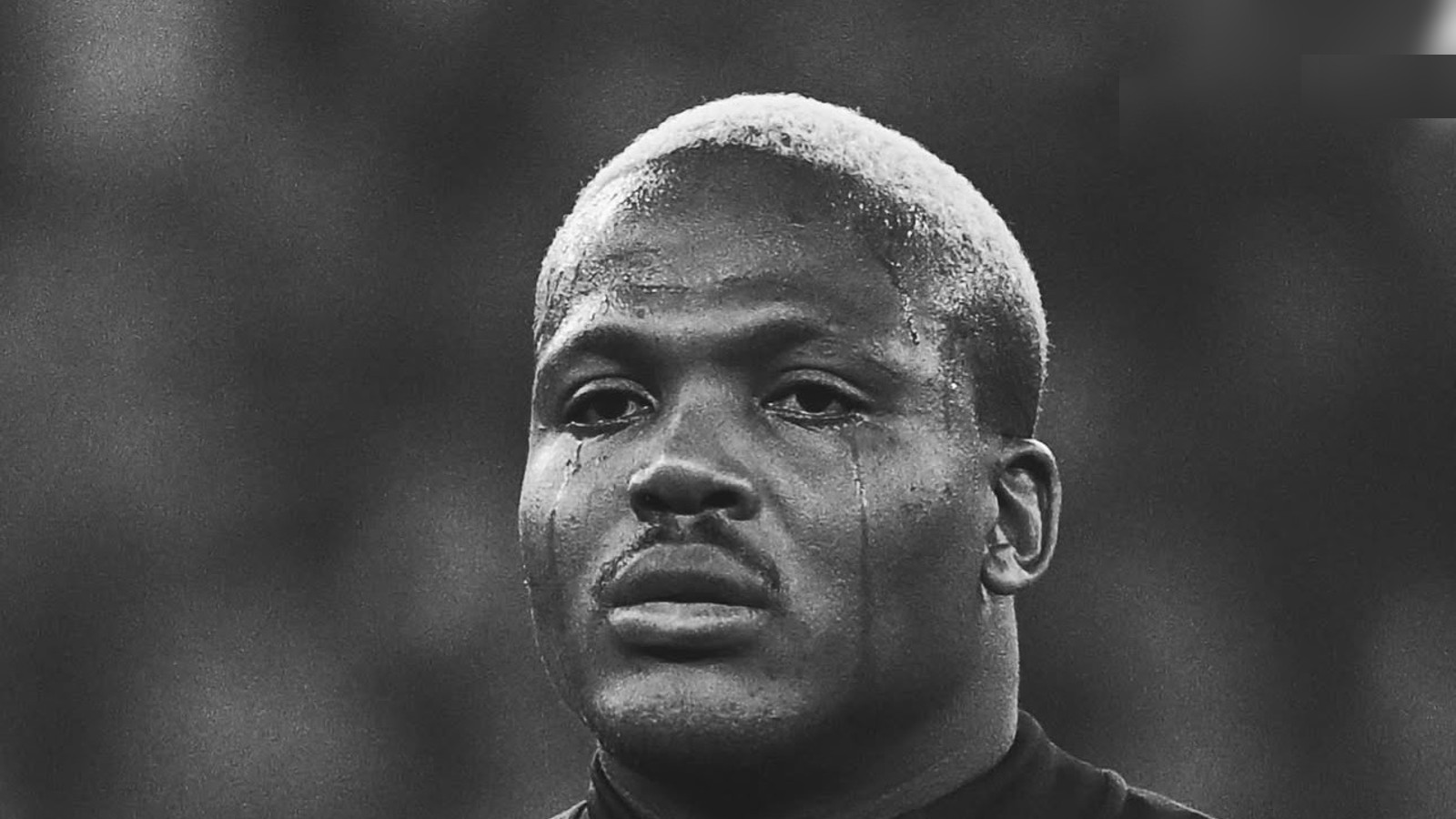
Now listen up, gang — every so often this country builds a loose forward so quick the broadcast cameramen file a formal complaint, and then spends the next eight years staring straight at him going “sorry, who’s this?” That is the whole Hacjivah Dayimani story in one breath, and it does NOT begin in one of those manicured rugby greenhouses where the U14 A-team gets a team psychologist, a nutritionist and a smoothie bar. It begins at Jeppe High School for Boys — a public school in Joburg, old as the hills, no swimming-pool-shaped scholarships — with a kid who came up the hard way and ran like the fees were chasing him.
He’ll tell you himself what that climb cost, and he did, years later, standing on a Test field with the anthem playing: “They judge us by the heights we’ve reached, but rarely by the depths we had to climb from.” Hold onto that sentence, because it’s the spine of everything that follows. This is a man who measures the miles nobody else bothers to count. By the 2017 World Rugby U20 Championship he was in the Junior Springbok back row, moving like a man who’d been fired out of a cannon and decided he liked the view up there. Public school, age-group grades, national junior side — the pipeline worked exactly the way the brochures promise it will. Remember the address: Jeppe, not the greenhouse. Because the rest of this saga is a country that adores a rags-to-riches story right up until the exact moment it has to actually pick one.
Here’s where the legend gets its engine. Dayimani comes through at the Lions — Golden Lions, then Emirates Lions — a franchise that at the time practically lived in Super Rugby finals, a side already sprinting flat out before he arrived. And into that machine walks a No. 8 who outruns his own backline to the tryline like he’s just remembered he left the stove on at home.
This is the era that minted the nickname the whole country still uses: the fastest forward in the land. Long-range solo tries that had commentators laughing mid-sentence. Highlight reels doing numbers while the man himself was still catching his breath under the posts. A forward built with a wing’s engine, deployed right across the back row — Super Rugby, the Currie Cup, Super Rugby Unlocked, the Pro14 and the Rainbow Cup, as the whole rugby world got picked up and reshuffled during those strange plague years. He was appointment television.
And here’s the running gag that isn’t actually funny: the more the clips went bonkers, the more one particular phone stayed silent. The green-and-gold selection room developed, early and often, a very convenient case of not-at-my-desk whenever Dayimani’s tape started rolling. The country saw it. The country said it, loudly, every weekend. The room looked at its shoes and changed the subject.
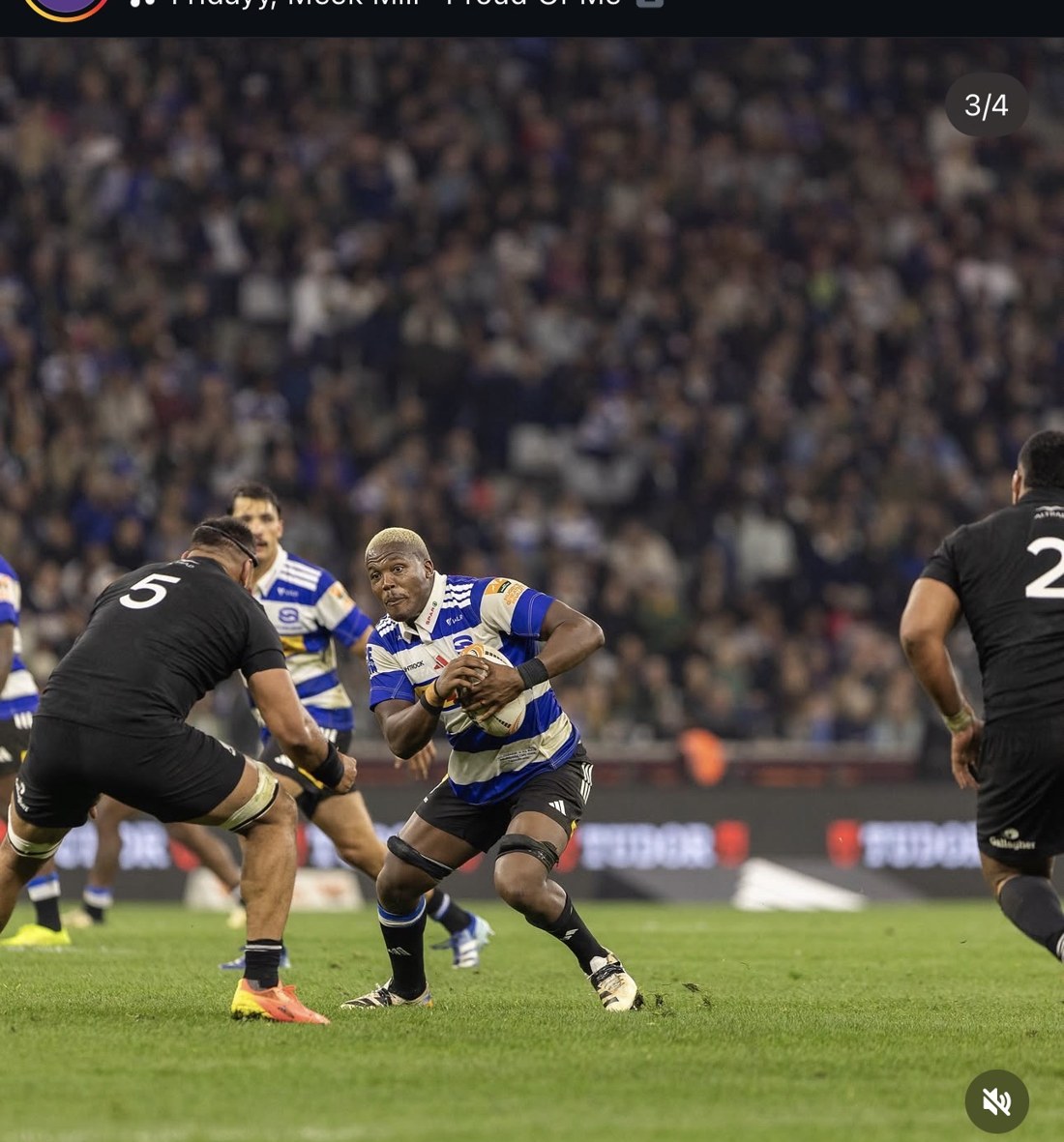
Full flight in Western Province hoops against the All Blacks — the fastest forward in the land.
So around 2021 he does what a South African does when Plan A ghosts him: he packs a bag for the Cape. Best decision he could have made, because he walks straight into silverware. The Stormers win the inaugural United Rugby Championship — the 2021/22 title — Cape Town bouncing clean off its hinges, a brand-new trophy for a brand-new competition, and Dayimani part of the furniture of it.
Then come the European nights, the Champions Cup lights, and THE one against Sale Sharks — the game they still clip and re-post to this day — where he takes the ball and runs through roughly the entire away team, beating something like ten defenders on a single carry, the kind of run that makes a professional defence look like it was arranged by a rival supporter, propelling the Stormers to a 31–24 win and taking man of the match. And right on cue, the whole country pointing at the television asking the same question they’d been asking since the Lions days: “How is this man not a Springbok?” And the selection room, once again, mysteriously away from its desk. Out of office. Back Monday. Please leave a message.
In 2024 the story crosses the water: Dayimani signs for Racing 92 in the French Top 14. And let’s be honest about why he left, because it isn’t wanderlust — it’s a door shut in his face. In May 2024, after being overlooked for the Springbok alignment camp in Cape Town while still contracted to the Stormers, Dayimani made it known he wanted out of South Africa. The headline didn’t dance around it: “Rassie’s rejection pushes Dayimani to France.” Rassie Erasmus had picked Elrigh Louw and Mpilo Gumede ahead of him, and explained it in the language of a loose forward’s “roadmap” — “how many battles you get into and how many battles you win.” File that sentence under Exhibit A; we’ll need it later.
So he goes to Paris — a two-year deal with an option on a third, into Stuart Lancaster’s rebuild, lining up alongside a former England captain in Owen Farrell. And he does not go quietly into the Top 14. On his return to action in October 2024 he marks it with a try and two assists in a man-of-the-match-grade performance that drives Racing to their fourth win of the season — the explosive ball-carrier breaking the line and making tries for other people, which, last we checked, is the exact job description a Test team claims to be shopping for.
And that October afternoon was no one-off flash in the pan. He debuted in September 2024 and went straight into the engine room of Lancaster’s side, and across that first campaign in Paris he stacked up 16 appearances spread over the Top 14 and the Heineken Champions Cup — Europe’s biggest club stage — with two tries on the board and that try-and-two-assist demolition as the headline act. Week after week it’s the same tape: the line-break that folds a defence, the offload out the back of the tackle, the carry that drags three men in before the ball’s even gone. A specialist loose forward doing specialist loose-forward things, in a foreign league, under a world-class coach, in front of the whole planet — including, one assumes, a Springbok analyst or two with a login and a pause button.
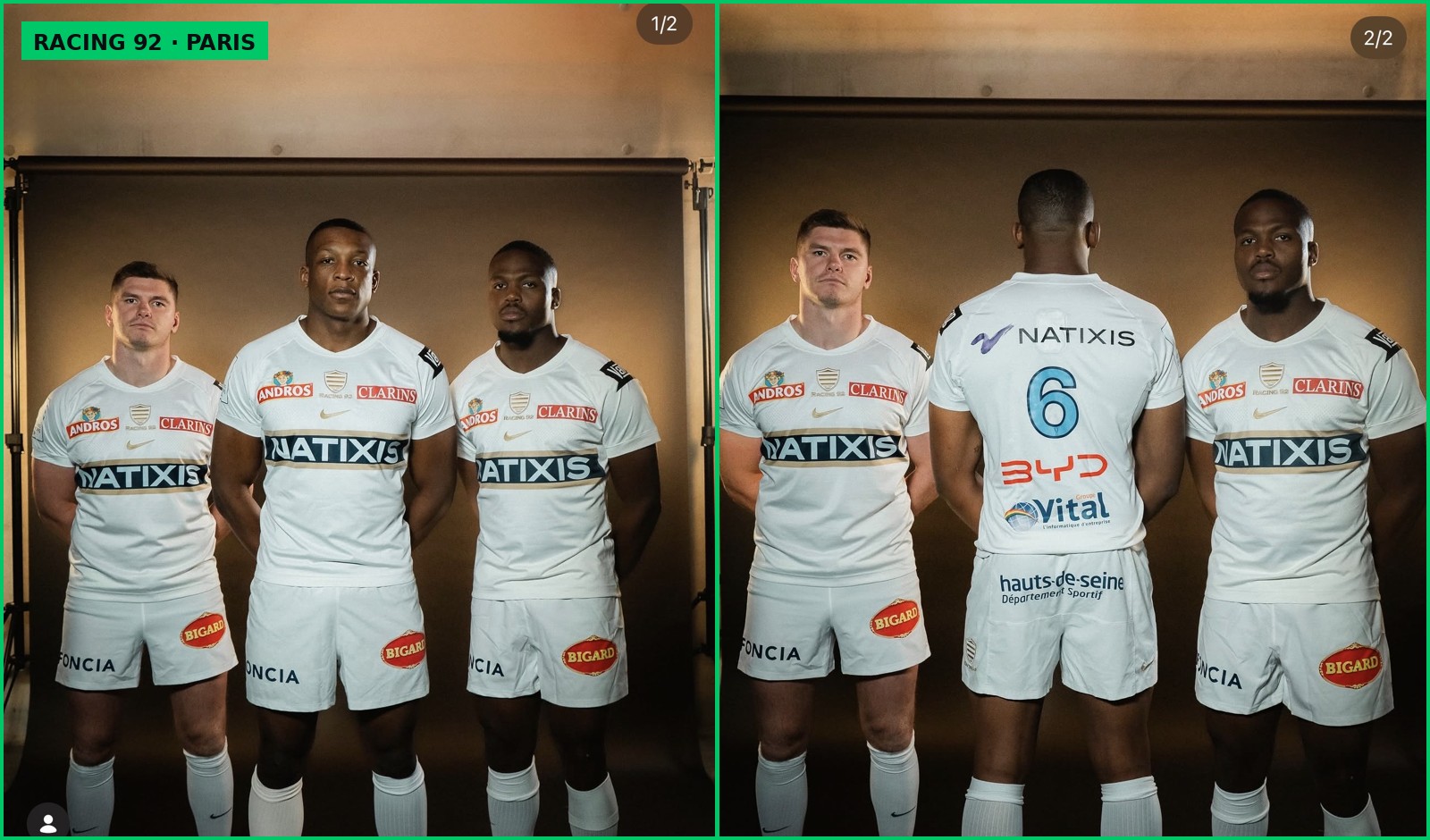
Racing 92, Paris — lined up alongside Owen Farrell (far left). Dayimani wore No. 6.
But to understand the room he’d walked into, understand what French rugby politics had just done — that very year — to the most famous South African forward alive. Siya Kolisi — World Cup-winning captain, the man who lifted the thing twice — had signed for Racing 92 from the Sharks in 2023 on a reported salary around €1 million. Then the honeymoon curdled fast: a 2023/24 season chewed up by injuries, hand surgery, an ankle knock against Toulouse, a dip in form that anyone who’s ever been hurt at their job would recognise in a heartbeat. And then Racing’s president, Jacky Lorenzetti, stood up in the French press — Midi Olympique — and described his own World Cup-winning employee in terms you wouldn’t use for a second-hand fridge you were trying to offload on Gumtree: that he’d gained weight, lost shape, gone “transparent.” Rassie Erasmus fired straight back on Siya’s behalf with the line that shot round the entire planet: “Siya’s not fat and Siya’s not transparent.” The marriage ended in a mutual “it’s not you, it’s… actually, on reflection, it might be you,” and Kolisi went home to the Sharks in September 2024.
Now read the room Dayimani had signed into. This is the ecosystem South African forwards keep EMIGRATING toward in order to finally be seen — and it had just told a two-time World Cup winner, out loud, in a newspaper, that he’d gone see-through. If Paris will do that to Siya Kolisi, what’s it going to do for the fastest forward his own country wouldn’t even camp with? He went anyway. Sometimes the away game is the only game they’ll let you onto the field for — and he went and scored and set up tries the moment he got there.
Then, in February 2026, the wheel turns. Dayimani comes home to the DHL Stormers on a short-term deal, and — this is the detail that makes the whole clubhouse sit up straight — John Dobson reportedly urgently contacted him to get it done, with the stated motive a genuine run at 2027 Rugby World Cup selection.
Chew slowly on the shape of that. The fastest forward in the country left, in part, because the phone never rang. And now the phone doesn’t just ring — it rings urgently, the exact moment a World Cup crests the horizon. Nine years of “not quite,” of “one to watch,” of “maybe next window” — and then, suddenly, a five-alarm rush to get his name onto a page. The man Rassie once passed over for not winning enough “battles” is, all of a sudden, a five-minute-ago priority the second there’s a squad to fill.
And they threw him straight into the deepest end there is: 7 August 2026, DHL Stadium, the opener of “Rugby’s Greatest Rivalry” — the DHL Stormers against the All Blacks. Here’s the cruel little punchline, though, and we’re not going to hide it: on the biggest night they’d give him, with the injuries piling up, they moved the country’s fastest loose forward out onto the wing. A No. 8 and flanker by trade, asked to play a job that was never his. And it bit him — Josh Jacomb kicked smartly into the space, Dayimani went to clear from the unfamiliar touchline, and Josh Moorby charged it down and regathered to score. The one blemish of his comeback came doing the one job he was never picked for. The Stormers went down 38–21 — but they went down swinging, gallant in defeat, the kind of loss the Cape press filed under “lost but won.” He’d flown home to be seen. They put him on the wing and the highlight reel remembered the charge-down. Read that twice, and then ask yourself whose fault that framing really is.
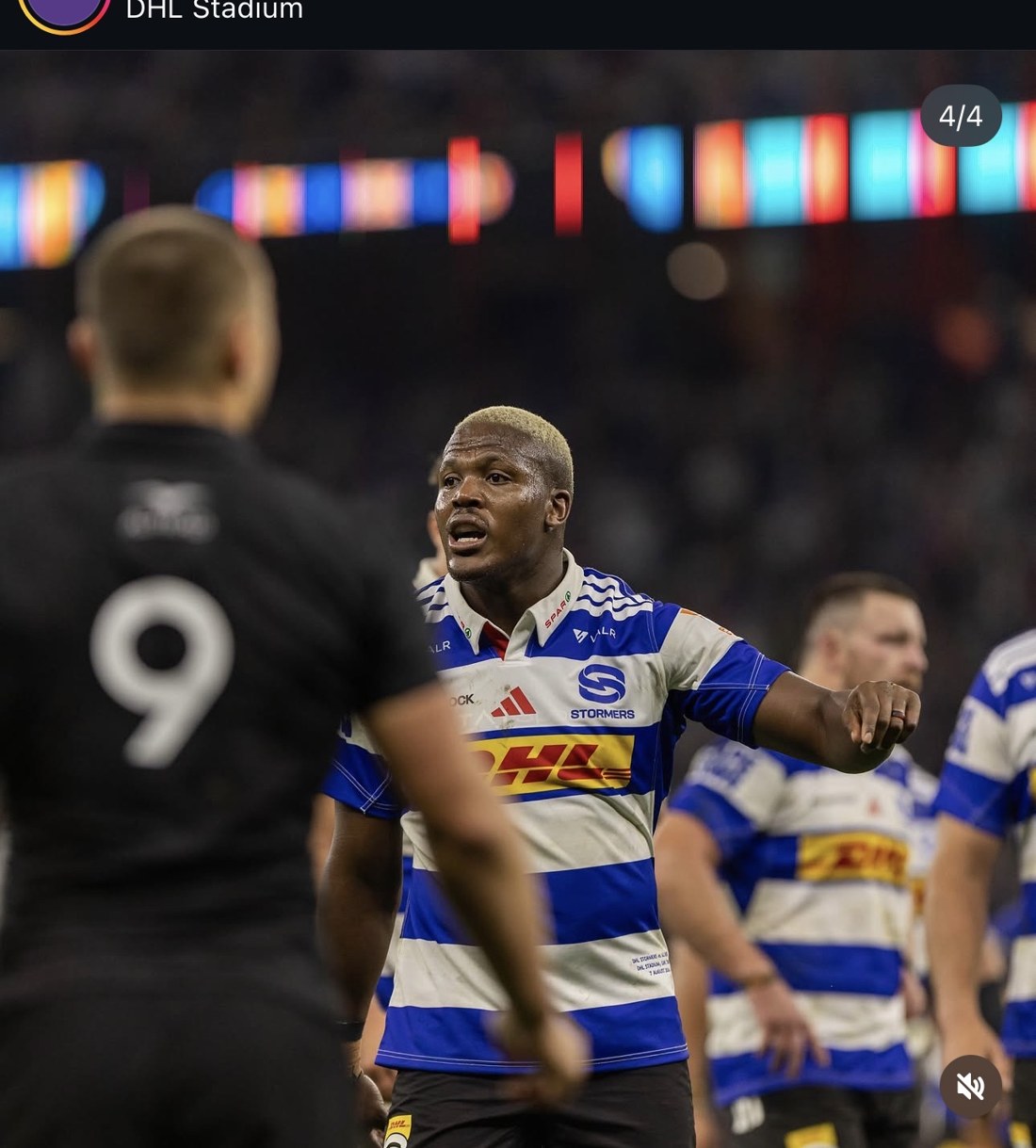
7 August 2026, DHL Stadium — organising the line against the All Blacks.
Here’s the thing about an audition: sometimes the biggest moment isn’t a carry or a line-break — it’s four minutes of standing dead still. Before the DHL Stormers went down swinging to the All Blacks that night in Cape Town, before the charge-down and the 38–21, the cameras found Hacjivah Dayimani during the national anthem. And the fastest forward in the country was crying. Not one photogenic tear for the highlight package — streaming. A grown wrecking ball of a man, in front of a packed DHL Stadium and a global broadcast, completely undone by a song.
And then he told you exactly why, in his own words, on his own page — and you should read all of it, not just the tidy bits:
Sit with the cruelty and the beauty of that, stacked on top of each other. This is a man weeping with gratitude for the chance to run out against the All Blacks — for a franchise, in a blue-and-white jersey that is not green and gold — because the green and gold has spent the better part of a decade letting his calls ring out. He isn’t crying over a trophy, or a Test cap he’s never once been handed. He’s crying because he made it back onto a field at all. “How many closed ones had to redirect me.” Read that line one more time, slowly, and have a think about exactly who kept a couple of those particular doors shut.
Because that’s the gut-punch of the whole night. The scoreboard went New Zealand’s way, and the scoreboard was never the assignment — the audition was. And the most powerful thing Dayimani did on the biggest stage anyone would give him wasn’t a run, or a hit, or a turnover. It was standing still, in floods of tears, singing a country’s anthem back to a country that keeps mislaying his name. A man that fast, that gifted, that decorated, reduced to gratitude just to be allowed on the grass — that’s not a rugby story anymore. That is THE story. And if that image doesn’t move the room, then nothing else in this whole file ever will.
Cameras off, and say it with the whole clubhouse: ScrumAtMe accuses nobody of anything. We note facts. We ask questions. We keep receipts. That is the entire job, and we’re about to do it out loud, slowly, with the coach’s own words in our hands.
Because the words are generous, and we’re going to quote them generously. At the FW de Klerk Foundation Annual Conference in February 2025, Rassie Erasmus laid out the philosophy that built the modern Springboks, and it’s a genuinely good one. He talked about the Elite Player Development pathway they started back in 2013 — the deliberate, patient, unglamorous work of getting knowledge, mentors, nutrition and opportunity to boys whose fathers and grandfathers had the right to play for South Africa taken clean away from them. He explained, better than most pundits ever have, why so many gifted players of colour end up out on the wing: the access story, the kid on a strip of grass or a dirt road with a “ball” made of rolled-up socks, learning to side-step and goose-step and round a man because nobody within a hundred kilometres owned a scrum machine or a tackle bag. He described building a database, three deep in every position, and refusing to do it the ugly way — “we will not white out, black in.” He called quotas a word he hates, “embarrassing on both sides.” He said a player has to feel safe: “if you don’t embarrass him about something that he can’t control, and he can express himself, then we’ll have a happy team.” And on selection he gave his personal word: “we don’t count numbers, we count talent.” Frame that. Hang it in every clubhouse in the land.
Then he told the Mapimpi story, and this is the one we have to get exactly right, because half a quote is a lie and we don’t tell those. Makazole Mapimpi wrote a message on his hand at the 2019 World Cup, and Rassie’s first, honest reaction was irritation — “it irritates me, side shows, when we’re on the field, ’cause I want us to think about rugby and how we’re going to win.” That’s the quote. And here is the whole of it, in full, because the whole of it is the entire point: he then took the time to ask why. Mapimpi told him it was for a woman who’d been killed at a post office in Cape Town — that he’d played, and scored, for her. Rassie listened. He understood. The irritation melted clean away — “I thought, okay.” And then that same squad started putting fans’ social-media messages up on a big screen in the team room on lonely Friday nights in Japan, and that — the very thing that had first annoyed him — became the emotional engine that made a bunch of tired men want to play for the whole of South Africa. He even told the room how much he came to rate Mapimpi as a man: the wing who tore a meniscus against Australia and finished the game anyway, when the coach had wrongly thought he was loafing; the kid who grew up so poor he played with a brick for a toy car and put “mags” on it. That is a coach who hated the side show until he took the time to understand the man behind it. Real, genuine credit to him for that. It is the best thing in the speech, and we will not let anyone trim it out.
So now — only now, with all of that on the table and none of it hidden — we get to ask our question. And it is only a question. He took the time with Mapimpi. He put it on the record, at a podium, that a man should be allowed to express himself, that the Boks count talent, not numbers. A gorgeous, generous standard. So hold it up, gently, against Hacjivah Dayimani — bleach-blond fade, Meek Mill’s “Proud Of Me” scoring his own posts, joy turned all the way up to the red line, a URC winner, a Champions Cup man-of-the-match, a genuine wrecking ball, the fastest forward in the country. And ask the room the simplest question in the world: has anyone taken that same time with him? Because for all of the form, and all of the noise, and all of the years, we have watched the entire rise from Jeppe to Paris and back, and we still have not seen one single green-and-gold training camp. Time was found to understand one expressive man until his “side show” became the team’s heartbeat. Was that same time ever, once, found for this one?
And the timeline is tugging a second thread while we’re all standing here. By the count going round, Makazole Mapimpi himself — the very player that beautiful story was about — reportedly hasn’t been picked for the Springboks in something like his last ten games. Sit with the symmetry of that for a second. The expressive man the coach once took the time to understand, now watching from the outside. The expressive man nobody has taken the time on yet, still uncapped at senior level. A modelling contract on one CV, a bleach-blond fade and a rap soundtrack on the other, elite form on both — and a strange, quietly growing amount of grandstand between them and the field. We are not saying that means a single thing. We are saying, plainly, on the record, in our own voice: we noticed. And judging by our timeline, so did a whole lot of you.
That’s the whole play, and it’s the disciplined one: quote the man accurately and in full, lay the facts down side by side, ask the question you are allowed to ask, and then flatly refuse to hand down a verdict we cannot prove. We do not know why the fastest forward in the country has never seen a camp. Nobody outside that selection room does. But the file is open, the receipts are filed, and ScrumAtMe and the ScrumAtMe Army are watching, and we are paying attention. This never happened. You decide.