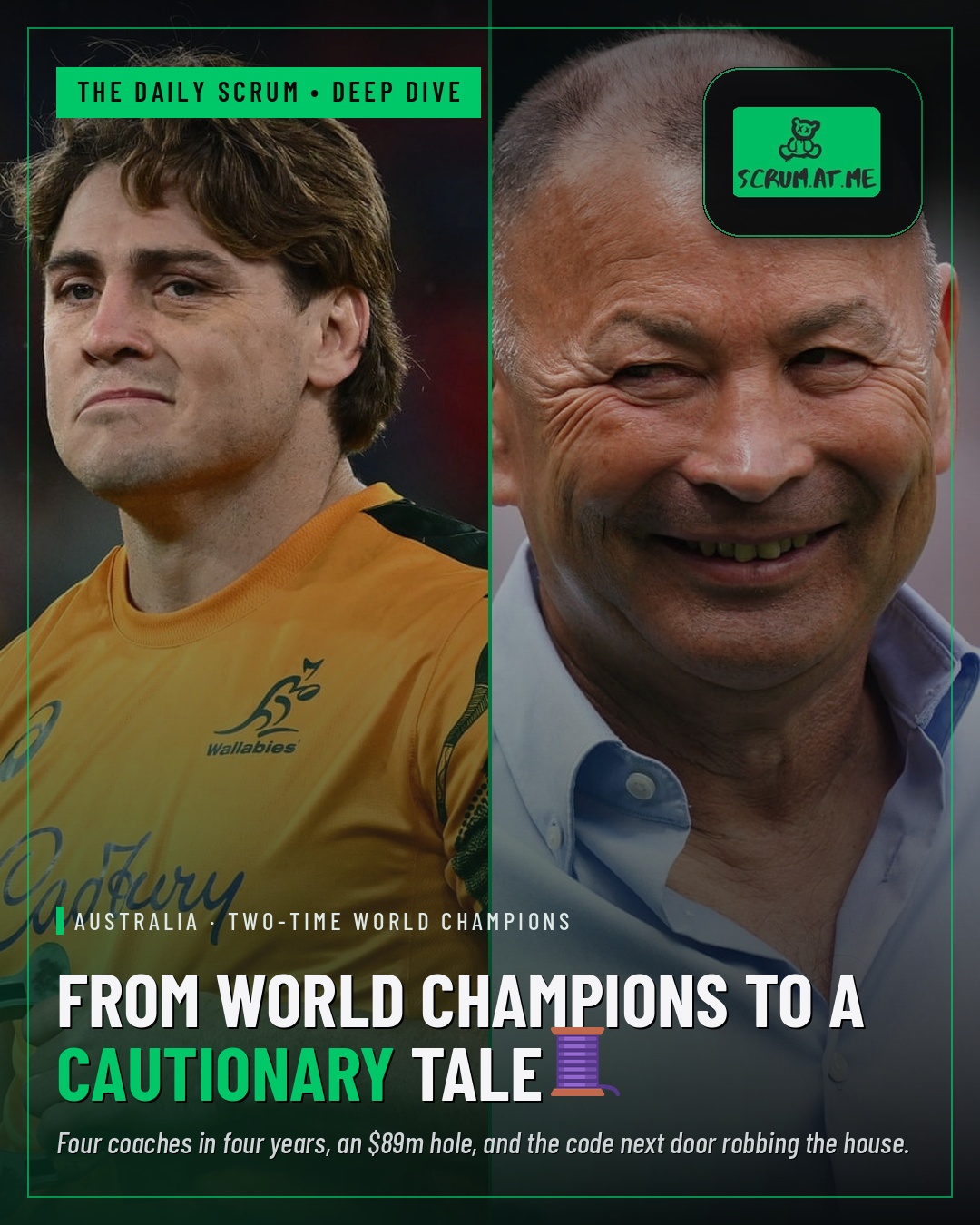
Australia are two-time world champions. Hold onto that, because everything from here reads like fiction if you forget where these people started. This is one story with four fires burning at once — on the field, in the courtroom, in the bank, and across the fence in rugby league — and they all feed each other. Let's take them one at a time and then watch them meet.
Let's date the fall properly, because it didn't happen overnight — it happened in slow motion, in public, with receipts. The last time Australia were genuinely at the summit was the 2015 World Cup: runners-up, ranked No. 2 in the world, a side that could live with anyone. That's the high-water mark. Everything since is the tide going out.
The first real crack showed at the 2019 World Cup in Japan. Australia walked into a quarter-final against England in Oita on 19 October 2019 and got taken apart 40–16. Michael Cheika resigned on the spot. That's the thing about this whole story — every chapter ends with a coach walking out of a building, and 2019 was just the first man through the door.
Dave Rennie took the job in 2020 and coached until they sacked him in January 2023. The final tally: roughly 13 wins from 34 Tests — about a 38% win rate, which at the time was reported as the worst of any Wallabies coach ever to take charge of 30 or more Tests. Sit with that number, because it's going to have company later.
It wasn't all grey. 2021 was genuinely good — a Quade Cooper-inspired run of five straight wins that dragged Australia back toward third in the world, the old swagger flickering back on. For a minute it looked like the patient was sitting up in bed.
Then 2022 kicked the bed over. A 2–1 home series loss to — of all people — Eddie Jones's England. A heavy beating by Argentina in San Juan. And then the one that actually broke new ground: on 12 November 2022, in Florence, Italy beat Australia for the first time in the history of the fixture, 28–27. Italy. First time ever. Australia's world ranking slid to eighth, then ninth — somewhere around the lowest it had ever been.
Two months later, in January 2023, Rennie was gone — sacked eight months out from a World Cup, with a full year still left on his contract. Remember that detail. Eight months out. A year still owed. It matters for what comes next.
Enter Eddie Jones, and a single calendar year so calamitous it deserves its own wing in the museum. His record as Wallabies coach: two wins from nine Tests. About 22%. Reported as the worst record of any full-time Wallabies coach in history — he didn't just lower the bar Rennie set, he dug under it.
Look at the pre-World-Cup slate, because Australia lost the lot. A 43–12 hiding by South Africa in Pretoria. A 34–31 home loss to Argentina in Sydney — beaten at home by the Pumas. A 38–7 dismantling by New Zealand at the MCG on 29 July, a result that handed the All Blacks the Rugby Championship on Australian soil. And a 41–17 loss to France in Paris on the way in. That's not a warm-up. That's a team walking into a World Cup already on fire and insisting the smoke is atmosphere.
The tournament itself, Pool C, was the earthquake. Australia opened by beating Georgia 35–15 on 9 September — fine, breathe. Then, on 17 September, they lost 22–15 to Fiji. Read that date and result and let it land: Fiji's first win over the Wallabies in sixty-nine years. Sixty-nine. And a week later, on 24 September, Wales finished the job, 40–6 — the heaviest World Cup defeat in Australian history. A dead-rubber 34–14 win over Portugal on 1 October was a fig leaf on a catastrophe. For the first time in the entire history of the tournament, Australia did not reach the knockout stage. Not "underperformed." Historic, stamped, permanent.
And Jones, standing in the wreckage after the Wales loss, gave the quote that sums the whole era up: "Whether we've hit rock bottom I don't know, but I've got to take responsibility for it." Mate — the scoreboard didn't share your uncertainty. Rock bottom had already sent up a flare, booked a venue and printed the T-shirts.
Then came Joe Schmidt, and — credit where it's due — a steadier hand. His first year, 2024, returned six wins from thirteen. That's not glory, but after 2/9 it felt like a spa retreat. Australia opened with home wins over Wales (25–16 in Sydney, 36–28 in Melbourne) and Georgia (40–29). Signs of a pulse.
But 2024 also produced the single worst afternoon in the country's Test history. On 7 September in Santa Fe, Argentina beat Australia 67–27 — a forty-point margin, the heaviest Test defeat the Wallabies have ever suffered. Sixty-seven points. You don't concede sixty-seven by accident; you concede sixty-seven when the whole system's unplugged.
And yet — and this is the maddening part about this team — a week's grace later they went to La Plata and beat the same Argentina 20–19 at the death, then beat New Zealand 24–19 in Sydney for a Bledisloe Test. A team capable of losing by forty and winning by one inside a fortnight isn't a bad team. It's an unwell one.
The 2024 spring tour was the genuine flicker of hope. On 9 November, Australia beat England 42–37 at Twickenham — their first win at that ground since 2015 — sealed by Max Jorgensen's try in the 84th minute, the kind of moment that rebuilds a program's belief. They followed it by putting 52–20 on Wales in Cardiff. They lost 27–13 to Scotland and lost a tight one, 22–19, to Ireland in Dublin — but they left that tour looking like a team climbing back up the rope.
2025 is where hope and horror share a calendar. The British & Irish Lions came, and it was tighter than the 2–1 scoreline suggests — the series was decided by an aggregate of 68–67. One point across three Tests. The Lions took the first 27–19 at Suncorp in Brisbane on 19 July, then clinched it 29–26 at the MCG on 26 July in front of a record Lions Test crowd of 90,307, and Australia salvaged the dead third Test 22–12 in Sydney on 2 August. Schmidt publicly disputed the legality of a clear-out in the build-up to the series-clinching try; World Rugby rejected the safety claim. Close enough to touch, and they still lost it.
And the same year produced a genuine signature win — a 38–22 comeback over South Africa at Ellis Park on 16 August, from 22–0 down, their first win at that ground since 1963. Proof, again, of the ceiling.
Then the floor. The November tour of 2025 went winless across four Tests — Australia's first winless European tour since 1958. A 25–7 loss to England. A 26–19 loss to Italy — the second straight time the Italians had beaten them, the first-ever loss now officially a habit. A 46–19 loss to Ireland, Ireland's record win over Australia. And a 48–33 loss to France in Paris that was the record tenth Test defeat of the calendar year — the most in Wallaby history — a total that cost them a top-six seeding for the 2027 World Cup draw and left them ranked seventh. Ten defeats in a year. A filing cabinet of them, dated and labelled.
Schmidt, who'd extended to mid-2026, bowed out in the July block. A 33–31 loss to Ireland in Sydney on 4 July. A 42–26 loss to France in Brisbane on 11 July. And then a farewell gift — a 57–10 demolition of Italy in Perth on 18 July, nine tries, snapping a six-match losing streak on the way out the door. His final Wallabies record: twelve wins from thirty-one Tests, about 38.7% — reported as a fraction better than Rennie's, and still, when you zoom out, the worst overall strike rate of any Wallabies coach in roughly fifty-five years. Let that sink in: the elite operator they brought in to fix it posted, by the raw percentage, the worst long-run return in half a century — because the problem was never only the man holding the whistle.
Which brings us to Les Kiss, coach number four, first Test on 8 August 2026: a 35–32 win over Japan in Osaka in which Australia went down to a red card and had to survive a late Japan rally to get home. A win's a win. But you don't want the opening line of the new era to be "survived Japan," and you definitely don't want it after everything above.
Four coaches in four years. Cheika out in 2019, Rennie sacked in 2023, Jones gone by October of the same year, Schmidt handing over in 2026. That's not a succession plan — that's a man changing all four tyres while the car's still rolling downhill, and the passengers keep arguing about who gets to steer.
Section 1 gave you the scoreline damage of the Eddie Jones year. This is the other damage — the institutional kind — because the way Australia hired him, and the way he left, is the single clearest x-ray of how the whole organisation was operating.
Rewind to the hire. Rugby Australia announced Jones's appointment on 16 January 2023, formally starting him on 29 January, on a deal reported to run all the way through the 2027 World Cup — widely reported as five years, about A$4.5m. This wasn't a stranger, either: Jones had coached the Wallabies before, from 2001 to 2005, taking them to the 2003 World Cup final — and had just been sacked by England in December 2022, weeks earlier. So Australia sacked a coach eight months from a World Cup, with a year left on his deal, to sign a man England had just let go, and handed him the keys through 2027.
At the unveiling, the promises were the size of Uluru. "It is a wonderful opportunity for me to be able to come home to Australia and lead my nation to a Rugby World Cup," Jones said, and then set the bar exactly where it could most spectacularly be missed: "I am confident that we can go to France and break the 24-year drought of winning the Rugby World Cup." Chairman Hamish McLennan called it "a major coup for Australian Rugby." A major coup. Hold that phrase; it doesn't age like wine. What the coup delivered was the earliest World Cup exit in the country's history.
And then the story stopped being about rugby. Because in the aftermath, the Sydney Morning Herald reported that Jones had held a Zoom interview with Japan Rugby Football Union officials on 25 August 2023 — two days before Australia's World Cup warm-up against France — positioning himself for the Japan head-coach job. Two days before a warm-up Test. Allegedly job-hunting for the lifeboat while still steering the ship into the tournament.
Jones denied it, and denied it, and denied it. "I haven't spoken to anyone." "I'm staying, mate. I've always been committed to Australian rugby and I want to leave it in a better place." "I am 100% committed to the job." He said he had "no idea" where the story even originated — the story, again, about his own alleged Zoom call. Former Wallaby Shane Horan didn't bother with a paragraph; he just posted the verdict: "Eddie, this is treachery Mate." And CEO Phil Waugh, to his eventual regret, initially took the shield down for him: "I take people at their word and Eddie's said there's nothing in it. So, as far as I'm concerned, that's the end of the story."
It was not the end of the story. Rugby Australia confirmed on 30 October 2023 that it had accepted Jones's resignation, effective 25 November. And on the way out, the quotes kept coming: "I've got no job to go to, no job offer." "My commitment to Australian rugby has been 100 per cent." And a parting shot at the very body that had just handed him A$4.5m: "Rugby Australia at the moment cannot activate the changes, financial and political, to make real change."
Then the punchline the facts wrote themselves. Japan re-appointed Eddie Jones as head coach on 14 December 2023 — less than seven weeks later. A man who swore he had "no job to go to" walked into a national head-coaching role in under fifty days, after allegedly interviewing for it back in August while still running someone else's World Cup. You can believe every word of every denial if you like. The calendar is an unkind witness.
And the reckoning reached the top. McLennan — the chairman who had driven the decision to sack Rennie and hire Jones, the man who'd called it "a major coup" — was himself forced out after a revolt by the state member unions, resigning as chairman on 19 November 2023 and being replaced by former Wallaby Daniel Herbert. The single worst appointment in the modern history of the program didn't just cost a season. It took out the coach and the chairman who made him. The plan was so radioactive it deleted its own authors.
You can't tell the story of the Wallabies' slide purely in scorelines, because a chunk of the damage happened off the field, in courtrooms and code-of-conduct hearings and airport terminals. Over a decade, Australia repeatedly lost players — captains, prodigies, first-choice starters, even a head coach — to off-field chaos before a single whistle blew. Here's the roll-call, straight, because the pattern is the point.
Start with the most serious, and the one that deserves the most care. In 2018 James Slipper — then the Queensland Reds captain and an 86-Test Wallaby prop, a genuine cornerstone — returned two positive cocaine tests from samples collected across roughly February to May 2018. Rugby Australia stood him down on 24 May 2018 and, under its Illicit Drugs Policy, handed him a two-month ban and a fine of about A$27,500, ruling him out of the June 2018 three-Test series against Ireland.
This is where the recount stays respectful, because Slipper himself disclosed that he'd been suffering from depression for about a year and was receiving support, and the tribunal weighed his personal circumstances and clean record. That's not a punchline; that's a man who was unwell and got help. And the ending is the one bright thread in this whole chapter: Slipper rebuilt his career, kept playing at the top, and went on to captain the Wallabies. Of everyone in this section, his standing recovered the most completely — a reminder that the story of a setback and the story of a person are not the same thing.
But hold the team-sheet consequence, because that's the throughline of this whole section: at the exact moment Australia were trying to steady themselves, they went into a home series against a world-class Ireland side without their captain and one of their most experienced props. The cost here isn't moral — it's a starting front-rower and a leader, subtracted from a team that could least afford subtractions.
Karmichael Hunt was one of Australian sport's rarest commodities: a three-code professional — Broncos and Kangaroos in league, the Gold Coast Suns in the AFL, and then a reported roughly A$600,000-a-year cross-code deal to bring him to the Reds from 2014. That's marquee money and marquee marketing. It came apart twice.
The first case, 2015: Hunt was arrested and charged in February as part of a Queensland Crime and Corruption Commission investigation into a Gold Coast cocaine syndicate. The commission alleged he and three others had arranged the supply of cocaine between June and December 2014 — while he was still an AFL player transitioning to the Reds. In court the supply charges were set aside and he faced four counts of possession; the tendered facts stated he had bought cocaine four times in September–October 2014, paying about A$1,100 for 3.5 grams on three occasions. On 5 March 2015 at Southport Magistrates Court he pleaded guilty to the four possession counts and was fined A$2,500 with no conviction recorded. Magistrate Catherine Pirie's line to him has aged into the whole saga's epigraph: "Your offences will become well known and be a disappointment to your legion of fans." The Reds and the ARU added a six-week suspension and a A$30,000 fine and stripped him of the vice-captaincy. They kept him. He rehabilitated his standing well enough to make his Wallabies debut in the June 2017 Test window.
And then, the second case. Hunt was arrested in Fortitude Valley, Brisbane, on 30 December 2017 — the initial charge cocaine possession, alongside contravening a police direction. The Reds stood him down again. On 19 February 2018 at Brisbane Magistrates Court the cocaine charge was dropped for insufficient evidence; he pleaded guilty instead to unauthorised possession of the prescription drug Xanax and to failing to report for fingerprinting, and was fined A$300 on each with no conviction recorded, his lawyer saying he'd used the Xanax for sleep amid stress. Rugby Australia's integrity unit called it a "low-level breach" but escalated the penalty because of the 2015 matter: a A$10,000 fine, a four-match suspension deemed already served, a twelve-month target-testing program and mandatory treatment. CEO Raelene Castle's line was the standard-issue one: "We take all matters of off-field behaviour seriously."
Here's where it actually hit the rugby. New Reds coach Brad Thorn, who ran a hard, zero-tolerance line on illicit substances, didn't pick Hunt for any of the 2018 season, and in December 2018 the Reds released him from the final year of his contract; he signed with the Waratahs for 2019. Michael Cheika had already left him out of Wallabies contention after the arrest, and he never won another cap. Phil Waugh's verdict was blunt: Hunt had "failed those who helped him." Strip the sympathy or the judgment out of it and the ledger is stark — a franchise poured cross-code marquee money into a three-code superstar and got, in the end, a handful of caps and two stand-downs for it. That's not just a personal story; that's a talent-and-money hole blown in a system that couldn't afford holes.
James O'Connor was a teenage prodigy from 2008 — one of the most gifted backs Australia had produced in a generation — and the Wallabies spent years losing and re-finding him. The off-field file starts early. In July 2013 the Melbourne Rebels declined to extend his contract, citing ill-discipline. During the June 2013 British & Irish Lions series he and Kurtley Beale were photographed at a Melbourne Hungry Jack's at about 3:50am after the Rebels' midweek loss to the Lions — the "Burger Boys" episode — though, to be accurate, Rugby Australia investigated and took no action, accepting they hadn't been drinking. (And to kill a myth while we're here: there is no documented "Byron Bay" incident; that's a conflation, and we deal in what's on the record.)
The decisive one came in September 2013. Hours after Australia beat Argentina in Perth, O'Connor tried to board an early flight to Bali and was removed from Perth International Airport by Australian Federal Police, whose statement said "it is alleged the man was intoxicated." Coach Ewen McKenzie stood him down, and on 3 October 2013 the ARU terminated the final year of his central contract — effectively ending his first Wallabies stint and pushing him overseas, to London Irish and then Toulon.
At Toulon came the case documented elsewhere in this project: in the early hours of 25 February 2017, O'Connor and former All Black Ali Williams were arrested outside a nightclub near the Champs-Élysées, with about 2.4 grams of cocaine involved. Williams was charged with buying and later fined €1,500 by a Paris court plus a further €1,500 by the French league; O'Connor was dealt with for possession, received no court fine, and was required to complete a behavioural course. Toulon suspended him on 28 February 2017, and president Mourad Boudjellal — in a line more sympathetic than most bosses manage — said "I blame it more on distress than stupidity" and "it's not cocaine that will do it for him," before confirming the expiring contract wouldn't be renewed. O'Connor moved to Sale.
And then, the rebuild — because this one has a genuine second act. O'Connor returned to the Reds in 2019, earned a recall for the 2019 World Cup, captained the Reds to the 2021 Super Rugby AU title, won a 2025 Super Rugby Pacific title with the Crusaders after being left out of Eddie Jones's 2023 World Cup squad, and — at 35, after an injury to Noah Lolesio — was given a shock recall by Joe Schmidt for the 2025 Lions series. The talent was always real. That's exactly what makes the lost years sting: this was a player Australia kept having to find twice.
Beale's issues were alcohol and conduct rather than drugs, but they belong here because of what they cost. In 2013, after a heavy Rebels loss, he was involved in a physical altercation with teammates and voluntarily entered rehabilitation, which he had to complete before he could be re-selected for the Wallabies. In June 2014 he had an in-flight altercation with Wallabies business manager Di Patston and was left out of the squad to face Argentina. And in October 2014 he faced a code-of-conduct tribunal over an offensive text message about Patston — a saga whose fallout contributed directly to coach Ewen McKenzie's resignation on 18 October 2014. Beale was fined A$45,000; his contract was not terminated. Read that consequence again, because it's the sharpest example of the whole section's thesis: this wasn't just a player suspended for a match. The off-field turmoil around it helped end a head coach's tenure. Australia's coaching carousel — the thing Section 1 spent all those scorelines documenting — didn't only spin because of results. Sometimes it spun because the off-field house was on fire.
Two more, briefly, because an honest recount includes them. In November 2013, before Australia's win over Ireland, McKenzie suspended six players one match each for a late-night Dublin drinking session — Adam Ashley-Cooper, Nick Cummins, Liam Gill, Tatafu Polota-Nau, Benn Robinson and Paddy Ryan — a group that, for the record, did not include Beale or O'Connor. And in 2019, Israel Folau's roughly A$4m contract was terminated in May over an Instagram post — a social-media conduct matter with no drug element, but one that cost Australia a first-choice fullback in the run-up to the 2019 World Cup. Different category, same net effect: a starter gone before a tournament.
One more, categorically different and worth flagging so it isn't miscounted: Waratahs centre Henry O'Donnell tested positive on 9 May 2025 for amphetamine metabolites tied to unauthorised ADHD medication and accepted an 18-month ban to January 2027. That's an anti-doping stimulant case, not a recreational one — a different rulebook, filed correctly.
Line it up and the pattern is undeniable. A captain and Test prop lost for a home series against Ireland. A three-code marquee signing who cost real money and delivered a handful of caps across two stand-downs. A generational back the country lost for years to airport terminals and off-field chaos and had to keep re-signing. A conduct saga that helped push a head coach out the door. A first-choice fullback gone before a World Cup. None of these on their own sinks a program. Stacked over a decade — on top of the coaching churn and the scorelines — they are exactly the kind of steady talent-and-stability leak that turns a superpower into a cautionary tale. The Wallabies didn't only lose Tests. Too often, they lost the players before the Test even started.
If the scoreboard told you the Wallabies were sick, the balance sheet told you the whole body was. Because while the on-field results were collapsing, Rugby Australia — the governing body that funds the entire pyramid, from the Test team down to the grassroots — was quietly running out of money. Not "tightening the belt" money problems. Red-ink, private-equity, are-we-going-to-make-payroll money problems. And the two crises fed each other: a losing team is a harder team to sell, and a broke union is a harder union to build a winning team inside. Here's how the books nearly buried them.
Start with the numbers, because the numbers escalate like a bad blood-pressure reading. For 2023, Rugby Australia posted a deficit of $9.6m. Bad, but survivable — the kind of number a big organisation can absorb for a year and promise to fix. Then came the 2024 figure, reported at the April 2025 AGM, and it was a different species entirely: a $36.8m deficit on the year's operations. Total revenue of $126.3m against costs of $156.4m. Read that gap out loud — they spent thirty million dollars more than they brought in, in a single year. That's not a rounding error or a bad quarter. That's a structural problem wearing a nice suit.
And the reasons matter, because they tell you this wasn't simply overspending on luxuries. A large chunk of that blowout came from Rugby Australia absorbing the operations of the Waratahs and the Brumbies — taking the running costs of Super Rugby franchises onto the national books. Another roughly $5m was tied to the defunct Melbourne Rebels, a team that no longer existed but was still, in effect, bleeding money onto RA's ledger. And more went into increased investment in women's rugby — the one line item in that list you'd actually defend, an investment in the future rather than a legacy cost of the past. But defensible or not, they all landed in the same column: out. The union was hoovering up the costs of a sport that wasn't paying for itself, and the meter was running.
Here's the part that should make any rugby person's stomach drop. In November 2023, amid the loss of a major sponsor — the kind of blow that turns a cash-flow squeeze into a cash-flow emergency — Rugby Australia finalised an $80m credit facility from Pacific Equity Partners. A private-equity loan. To keep a national sporting body running. (One factual correction worth nailing down, because it gets muddled: the lender was Pacific Equity Partners — not Barings. No source ties Barings to this. Get the name right or don't print it.)
They drew $63.5m of that facility by the end of 2023 alone — meaning within weeks of signing, they'd pulled down the bulk of an eighty-million-dollar loan just to function. And the debt kept climbing: it reportedly reached almost $89m in 2024, with about $9m spent that year just servicing the loan. Sit with that last number for a second. Nine million dollars — gone, not on players, not on coaches, not on grassroots, not on a single thing that makes a team better — gone on interest. Nine million dollars a year to rent money. That is the financial equivalent of the 67–27 in Santa Fe: a number so bad it stops being a statistic and starts being a symptom.
This is the trap a proud institution falls into when the operating model stops working. You don't wake up one morning and decide to borrow eighty million from a private-equity house. You get there one deficit at a time, one lost sponsor at a time, one absorbed franchise at a time, until the only door left open is the expensive one — and you walk through it because the alternative is the doors closing entirely.
Overlapping all of this was Rugby Australia's attempt to fix the structural problem at the root: a "strategic reset," launched in August 2023, to centralise the Super Rugby clubs' operations and player contracts under the national body. On paper it's sound logic — stop five separate entities duplicating costs and competing against each other, pool the money, control the contracts, run it as one system the way the successful rugby nations do. In practice, it was a civil war. The Waratahs signed up first, in November 2023 — the compliant one. But the Brumbies dug in, their chair Matt Nobbs initially calling Rugby Australia's treatment of the club "appalling." And the Queensland Reds resisted the commercial-takeover model outright, CEO Dave Hanham stating flatly, "we don't feel that's the right model." So the very reform meant to save the money turned the states against the centre, at the exact moment the centre could least afford a fight. The house was broke and now the family was arguing about who owned the furniture.
The sharpest single symbol of the whole financial crisis is the Melbourne Rebels. On 30 January 2024, the Rebels entered voluntary administration, owing about $9m. And Rugby Australia did not retain them. A Super Rugby franchise — a professional team, a pathway for players, a market in a major city — simply ceased to exist, cutting Australia's Super Rugby presence from five teams to four. Think about what that means for the talent pipeline this whole series has been mourning. Fewer teams means fewer professional contracts, fewer starting jerseys, fewer places for a young Australian to be developed rather than lost to league or to boredom. At the precise moment Australian rugby needed to be growing its playing base to climb back up, the finances forced it to shrink — to amputate a limb to keep the heart beating. You cannot rebuild a Test team's depth while you're deleting professional teams beneath it. The money problem wasn't just an accounting problem; it was a talent problem in disguise.
Now the turnaround — and it's real, and it's enormous, and it comes with an asterisk you can see from space. The 2025 British & Irish Lions tour was the financial rescue the union had been praying for. Rugby Australia reportedly cleared more than $100m from it — the Sydney Morning Herald put the figure as high as $120m. A single tour. In a single winter. And they used it exactly the way you'd hope a chastened organisation would. On 29 August 2025, Rugby Australia repaid the Pacific Equity Partners facility — more than a year early — and declared itself debt-free. Then it reported a record surplus of $70.6m for 2025. From a $36.8m deficit to a $70.6m surplus and zero debt, in the space of one Lions series. CEO Phil Waugh framed it the way you'd expect: the early repayment, he said, "reflects the commercial success of the British & Irish Lions series, cost discipline and the efficacy of Rugby Australia's organisational reset."
Here's the asterisk, though, and it's the whole point. The British & Irish Lions tour Australia roughly once every twelve years. You cannot run a national sport on an income event that shows up when a child born the last time it happened is old enough to drink. The Lions didn't fix the operating model that lost $36.8m — they paid off the credit card that the broken operating model had maxed out. The debt is gone; the machine that created the debt has been papered over, not rebuilt. It's the household that clears its overdraft with a lottery win and calls it a financial plan.
Which is why the whole strategy now leans on two dates: the men's 2027 World Cup and the women's 2029 World Cup, both hosted in Australia. Rugby Australia openly treats these as the financial foundation of the next decade — and in July 2026 it welcomed a $90m federal funding commitment tied to a legacy program, government money betting on the same horizon. And that's the beautiful, terrifying knot this series keeps tightening back into. The finances are now pinned to a home World Cup in 2027. The on-field program — four coaches in four years, the earliest pool exit in the country's history, a team ranked seventh — is also pinned to that home World Cup in 2027. The money and the rugby are betting on the same night. If the Wallabies are competitive and the tournament sells, the whole enterprise gets its foundation and the last few years become a survived scare. If the hosts stumble out of their own pool in front of a home crowd, the financial "foundation" and the sporting one crack on the same weekend. They fixed the balance sheet by borrowing against 2027. Now 2027 has to pay.
Every problem so far has been at least partly self-inflicted — the sackings, the conduct, the spending. This last one is a predator problem. Because right next door, sharing the same cities, the same schools, the same teenage bodies, sits rugby league — and over the last decade it has quietly out-muscled union for the one resource that actually matters: the players. You can survive bad coaches. You cannot survive losing the raw material.
Follow the money, because the money explains everything. Go back to 2012 and the two codes were basically level: the NRL salary cap and the Super Rugby AU cap both sat around A$4.4m per club. Twins. A kid choosing between the codes was choosing between roughly equal paydays. Then the lines split and never came back. By 2022 the NRL cap had risen about 150% — to roughly A$10m — while Super Rugby AU's had crawled up only about 25%, to about A$5.5m. And by 2026 the NRL's total cap was around A$11.95m, with top earners like Nathan Cleary sitting near A$1.3m a year — one player earning a meaningful fraction of a whole Super Rugby club's cap. That's not a gap any more. That's a canyon, and talent rolls downhill into the deeper pocket every single time. When one code can pay roughly double, it isn't really a recruitment battle. It's a bidding war where only one side brought a wallet.
Union's marquee counter-punch was real, and it was expensive: Joseph-Aukuso Suaalii's switch from the Sydney Roosters to union, announced 25 March 2023 and effective from October 2024 — a deal Waugh reported at A$4.8m over three years, with Suaalii himself citing the 2025 Lions tour and the home 2027 World Cup as his motivations. A genuine coup: union reaching over the fence and taking one of league's brightest young stars. League's boss, ARLC chairman Peter V'landys, did not take it gracefully — he took it hilariously. He mocked the move, calling union "boring, slow and hard-to-watch," and predicted Suaalii would "get terribly bored and return to rugby league." That's the confidence of a code that knows it holds the bigger cheque book: it can afford to lose one and laugh, because it knows the traffic mostly runs the other way. (For the record, union had made earlier league-to-union gains too — Suliasi Vunivalu from the Storm to the Reds in 2019, Marika Koroibete from the Storm to the Rebels in 2016–17 — so the door does swing both directions. It just swings a lot harder in one of them.)
Because for every Suaalii coming in, the traffic going out tells the truer story. Wallabies winger Mark Nawaqanitawase — a current Test player, not a fringe one — left for the Roosters, announced 7 December 2023 and effective 2025, on a deal reported at more than A$1m a season. He was described as the first active Wallaby to switch to league since Mat Rogers in 2007 — and, in the neatest and most brutal bit of symmetry in the whole saga, the Roosters were effectively replacing the Suaalii they'd lost to union with the Nawaqanitawase they took from it. League gave up a star to union and simply reached back over the fence and grabbed an equivalent one in return. That's not a trade between equals. That's a bigger animal taking what it wants and knowing the smaller one can't stop it.
Waugh, for his part, all but admitted union can't win this arms race, signalling Rugby Australia would not be repeating Suaalii-scale raids: "I think the game historically has spent more than we can afford." Read that in context and it's an extraordinary thing for a CEO to say out loud — we're the code that can't afford to fight for its own talent. There are, at least, retention wins: Max Jorgensen — the man whose 84th-minute try beat England at Twickenham — rejected NRL interest and on 28 January 2026 signed a five-year Rugby Australia deal reported at around A$900,000 a year, only the third five-year deal in RA history. When keeping one of your own young stars requires one of the three biggest contracts your union has ever written, you understand the pressure the fence is under.
Which brings the whole thing full circle to Suaalii, the A$4.8m man union spent big to bring home. Days after Les Kiss's first game in charge, Wallabies great Tim Horan went public — in a RugbyPass piece by Finn Morton on 9 August 2026, the day after the Japan Test — with the argument that Australia are wasting their most expensive asset by hiding him at outside centre, No. 13, where he barely touches the ball. "Joseph Suaalii is wasted at number 13. We're just not seeing enough of him," Horan said, and again: "Get him involved in the game. He's just being wasted at number 13." The evidence: six carries for under fifteen metres against Japan, and no try since the previous September. Horan's fix was to move him into the back three and change the fly-half, arguing "put him on the wing where he can use his height, we've seen what he did in the NRL." And it wasn't a lone voice — earlier in 2026, ex-Wallabies Morgan Turinui and Michael Hooper had made the same "wasted at 13" case about Suaalii's use at the Waratahs, Turinui flatly saying "it's time to shelve that 13 experiment."
Sit in the full absurdity of it. Union fought league, reached over the fence, and spent A$4.8m of money it has openly admitted it can't really afford to prise a generational talent back into the fifteen-man code — and then, when it finally had him, played him in the one position where his own legends agree he barely gets to touch the ball. They spent lottery-winner money on a Ferrari and then parked it in the garage so it wouldn't get scratched. In a story full of self-inflicted wounds, that might be the most on-brand of them all: Australia's biggest recruiting win, quietly wasted by Australia.
Put the four fires together and you don't have four problems — you have one. A team that burned four coaches in four years and posted the earliest World Cup exit in its history. A hire so vain it took out the coach and the chairman who made it, over an interview nobody would admit to until Japan announced the job forty-five days later. A decade of players — a captain, a prodigy, marquee signings, a fullback — lost to off-field chaos before kickoff, and a coach lost with them. A union that spent itself into a private-equity loan, amputated a franchise it couldn't afford, and got rescued by a once-in-twelve-years tour it can't schedule again. And a rival code next door with double the money, calmly walking off with the raw material while union spends what little it has and then benches the very star it bought.
And every single one of those fires now points at the same date: the home World Cup in 2027. The rugby is betting on it. The money is betting on it. The whole comeback narrative is betting on it. Australia are two-time world champions — remember, that's where we started — and they've spent a decade handing pieces of that inheritance back, to sackings and courtrooms and creditors and the code across the fence. Something has to change, and it has to change before 2027, because when a founding pillar of a small sport leans this far, the whole structure feels it — a softer Rugby Championship, a Bledisloe that hasn't moved since 2002, a global game that needs its giants standing. The lucky country ran clean out of luck. Now it has about a year to make some of its own.