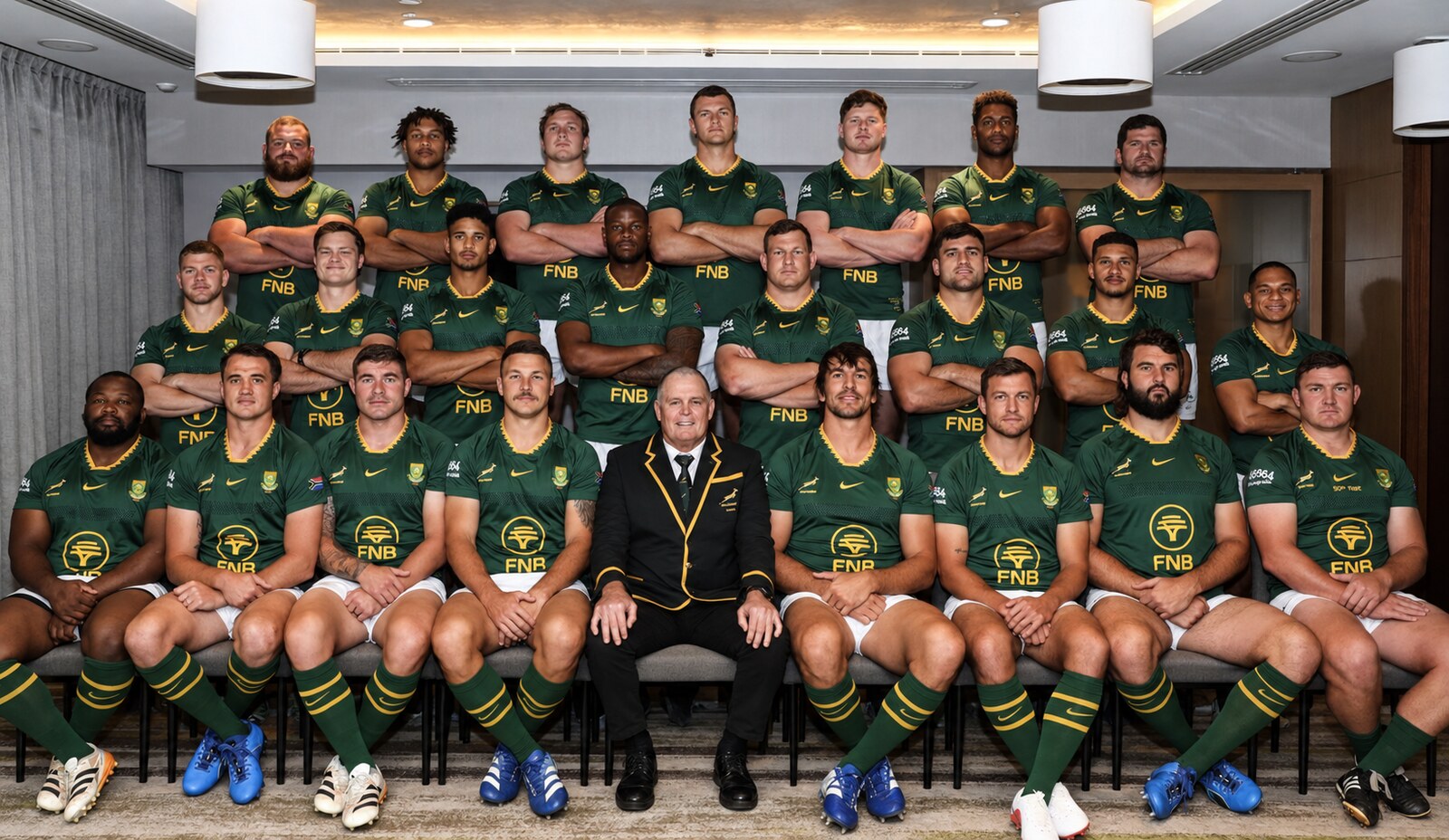
OPEN THE FILES.
There are stories where you need to manufacture controversy.
This is not one of them.
Look at the numbers.
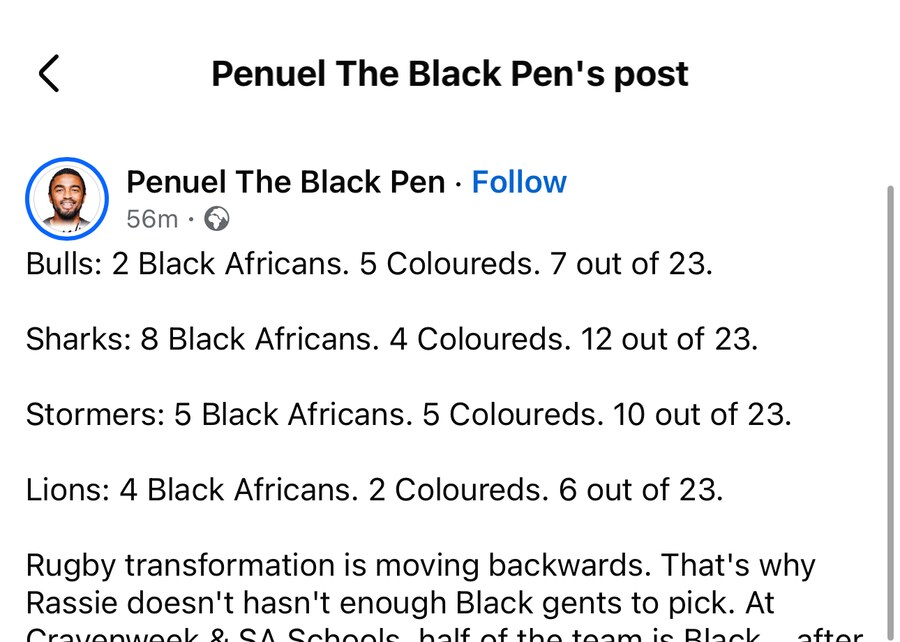
Across the four franchises, there were 92 matchday places. Of those, 19 were occupied by Black African players and 16 by Coloured players — 35 combined, or 38%. The remaining 57 places accounted for 62% of the selections.
The breakdown:
Bulls — 7/23 players of colour — 30.4%.
Lions — 6/23 — 26.1%.
Stormers — 10/23 — 43.5%.
Sharks — 12/23 — 52.2%.
Now put those numbers beside South Africa itself.
Stats SA's latest 2026 estimate puts the country at 63.52 million people: 81.7% Black African, 8.4% Coloured, 2.7% Indian/Asian and 7.1% white.
And now look at who sits at the top of the four professional rugby programmes: Johan Ackermann at the Bulls, Ivan van Rooyen at the Lions, John Dobson at the Stormers and JP Pietersen at the Sharks.
Three of those four top rugby positions are occupied by white coaches. Pietersen, whose own public comments identify him among people of colour, is the exception.
75% white at the top.
25% person of colour.
And the only franchise led by a person of colour this weekend also had the highest representation of players of colour.
Interesting.
But that's not even the missile.
Because if this was simply one strange weekend, we'd have a provocative graphic.
It isn't.
This story goes backwards through South African rugby — through recruitment, academies, professional contracts and development — and then it goes all the way up to the Springboks.
Nahhh.
THIS ISN'T REALLY ABOUT FOUR TEAM SHEETS
Start with the obvious response.
Maybe these were simply the best players available. Maybe injuries affected selection. Maybe Springbok call-ups affected selection. Maybe recruitment affected selection. Maybe certain positions had fewer options. Maybe provincial demographics matter. Maybe rugby participation isn’t distributed evenly across South Africa.
All possible.
But none answers the central question.
A professional rugby player does not spontaneously appear at Loftus, Ellis Park, Kings Park or Cape Town Stadium ready to play URC rugby.
Before the team sheet comes the professional contract. Before the contract comes the academy. Before the academy comes recruitment. Before recruitment comes scouting. And before scouting comes access to rugby.
At every stage, somebody decides who gets seen, who gets recruited, who receives a bursary or accommodation, who enters an academy, who receives specialist coaching, who starts, who sits, who is promoted, who is retained and who is released.
Those decisions also determine who is described as “raw”, who is considered “promising”, who is judged “not ready” and who receives another season to become ready.
Eventually, after that entire sequence of decisions, we arrive at the question everybody sees:
WHO BECOMES AVAILABLE TO SELECT?
That’s why “natural selection” isn’t enough.
There is nothing particularly natural about professional rugby development. It is a structured competitive environment in which institutions determine access to resources, coaching, contracts and opportunity.
It is engineered.
AND WHERE DO YOU THINK THE SPRINGBOKS COME FROM?
This is the part that changes the entire investigation.
Eventually those four pathways meet at the highest level of South African rugby.
At the Springboks.
The Bulls produce Springboks. The Sharks produce Springboks. The Stormers produce Springboks. The Lions produce Springboks.
Players move between franchises and overseas clubs, obviously, so the pathway is not perfectly linear. But these domestic professional systems remain a major part of South Africa’s elite development structure.
And SA Rugby’s own transformation audit has already shown what happens further up that road.
In 2023, the Springbok transformation target was:
54% — “generic Black” players.
27% — Black African players.
During the Rugby Championship:
39% — generic Black.
13% — Black African.
At the World Cup:
38% — generic Black.
16% — Black African.
South Africa won the World Cup. They were the best team in the world.
And they still missed their own transformation targets.
That’s where this conversation gets much more serious.
If Black African representation is low at professional level and then remains below target at Springbok level, staring only at the national coach’s final 23 means staring at the last gate in a very long road.
What exactly is the Springbok coach supposed to select from?
That’s not a defence of the national team.
That’s the question.
If South African rugby wants more elite Black African Springboks, it needs more elite Black African players reaching the point where they are genuinely competing for Springbok selection.
Which means this investigation cannot begin with the Springbok jersey.
It has to begin with the road to it.
DON’T GIVE HIM THE SPRINGBOK JERSEY. GIVE HIM THE ROAD TO EARN IT.
That’s the entire issue.
Nobody should want a weaker Springbok side, and nobody should want a player wearing green and gold because somebody in an office needed another percentage point.
South Africa should want something far more powerful:
more players capable of earning the jersey.
More elite Black props, locks, flyhalves, centres and scrumhalves. More elite Black coaches. More competition. More depth.
More Springboks.
If you want the national team to transform without compromising excellence, then the professional system underneath it needs to produce a sufficiently deep pool of Test-quality players.
Transformation at its most ambitious is therefore not about reducing the standard. It is about expanding the population genuinely capable of reaching that standard.
And that’s why these URC numbers matter.
BECAUSE WE HAVE SEEN THIS BEFORE
The weekend numbers aren’t floating in isolation.
The figures in SA Rugby’s 2023 audit showed the four URC franchises at:
Stormers — 49%.
Sharks — 44%.
Lions — 33%.
Bulls — 28%.
Now look at our weekend snapshot:
Stormers — 43.5%.
Sharks — 52.2%.
Lions — 26.1%.
Bulls — 30.4%.
Different sample. Different season. Different circumstances.
But look at the broad pattern.
Sharks and Stormers higher. Lions and Bulls lower. Again.
That’s when this stops looking like one coach’s Saturday selection and starts looking like four development systems producing noticeably different outcomes.
That deserves investigation.
Because if franchises operating inside the same national rugby ecosystem repeatedly produce materially different representation figures, the relevant question is not simply who each coach selected this weekend.
The relevant question becomes:
What is different about the systems producing the players from whom those coaches select?
SO LET’S FOLLOW THE POWER
If we’re going to ask who gets to play professional rugby, asking only about players is pointless.
Who controls the organisations?
The Bulls’ professional structure has involved private investors alongside the Blue Bulls Rugby Union. The publicly announced 2019 transaction allocated 37% to Patrice Motsepe, 37% to Remgro and 26% to the union, although Remgro’s more recent portfolio information describes a 50% interest, so the exact current percentages should not be presented as settled without the latest share register.
The Lions have publicly identified Altmann Allers as majority shareholder.
The Stormers’ professional company is 74% controlled by the Red Disa Consortium.
The Sharks’ structure is: MVM Holdings 51%, with KwaZulu-Natal Rugby Union and SuperSport holding the remaining 49%.
Why does ownership matter?
Because coaches don’t appoint themselves, academies don’t fund themselves and recruitment strategies don’t write themselves.
Owners and boards appoint or oversee executives. Executives build structures. Structures employ coaches and high-performance departments. Those departments recruit, retain, develop and ultimately select players.
There is a chain of responsibility.
So when somebody says:
“That’s just who the coach selected.”
Okay.
Who built the system from which the coach was selecting?
THE BULLS: 7 OUT OF 23
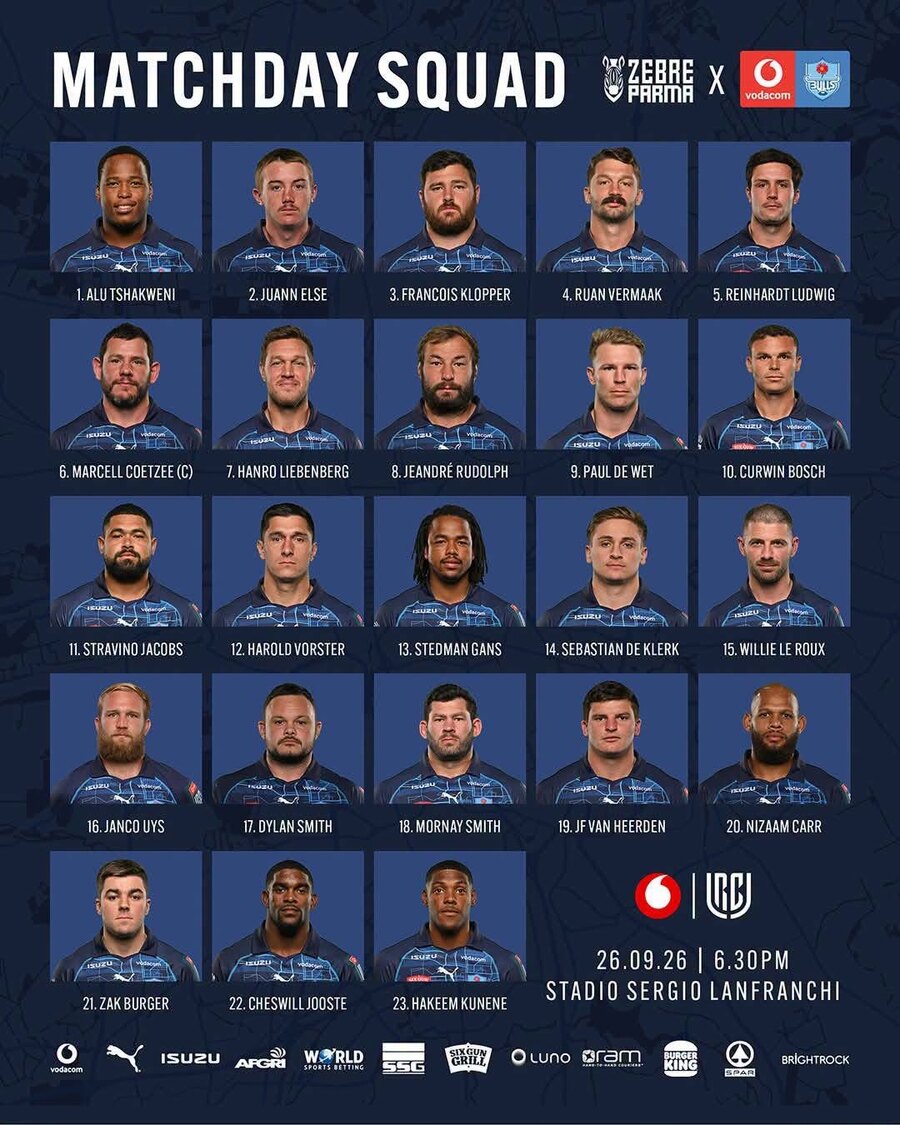
30.4%.
Johan Ackermann is head coach. Edgar Rathbone is CEO. The senior rugby structure identified in our research includes Neil de Bruin, Werner Kruger, Phiwe Nomlomo, Kennedy Tsimba, Jean Tiedt and Vlok Cilliers.
And this is where simplistic racial storytelling immediately runs into a wall.
The Bulls have had substantial Black ownership participation through Patrice Motsepe.
So we’re not going to write some lazy: WHITE OWNER → WHITE COACH → WHITE TEAM story.
The facts won’t carry it.
The better question is harder.
If substantial Black ownership participation exists and the organisation operates under South African rugby’s transformation framework, why does the professional outcome remain at 30.4% in this snapshot?
Who controls development? What does the academy look like? What does the U20 pipeline look like? How many Black African players are being signed, retained and given meaningful senior minutes?
Because 7 of 23 is the end of the process.
ScrumAtMe wants to see the beginning.
THE LIONS: 6 OUT OF 23
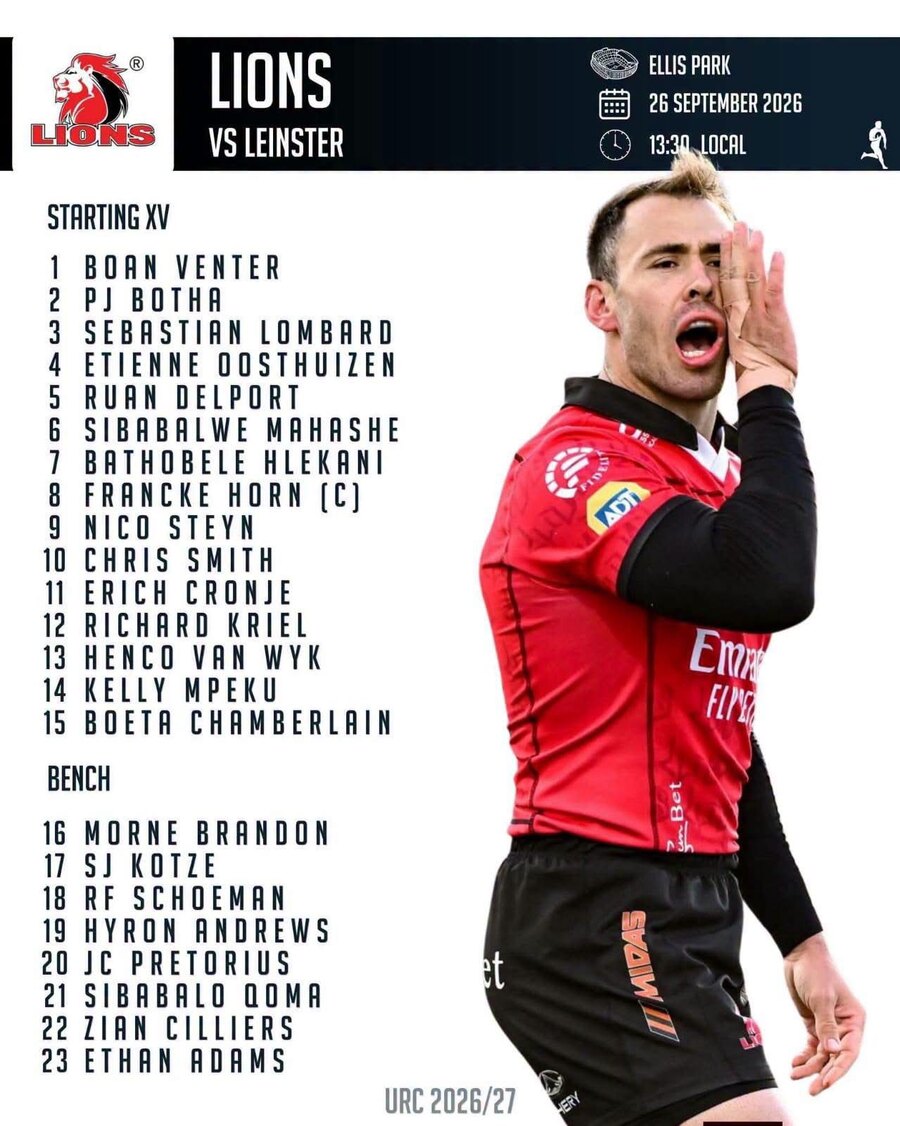
26.1%.
Lowest of the four.
Ivan van Rooyen is head coach. Altmann Allers is publicly identified as majority shareholder.
And here’s where the Lions become particularly interesting.
The organisation has publicly defended continuity and promotion from within.
Good.
Then show us within.
If your philosophy is to develop and promote internally, the demographics of the final senior team cannot be separated from the demographics of the system feeding it.
Who enters, who receives contracts, who is developed, who is promoted, who becomes a coach or selector and who survives the pathway are not external variables. They are part of the institution’s own development process.
An internal-development philosophy therefore gives the organisation more ownership of the outcome, not less.
You cannot say: “We promote from within.” And then treat whatever comes out the other side as nature.
You control the within.
THE STORMERS: 10 OUT OF 23
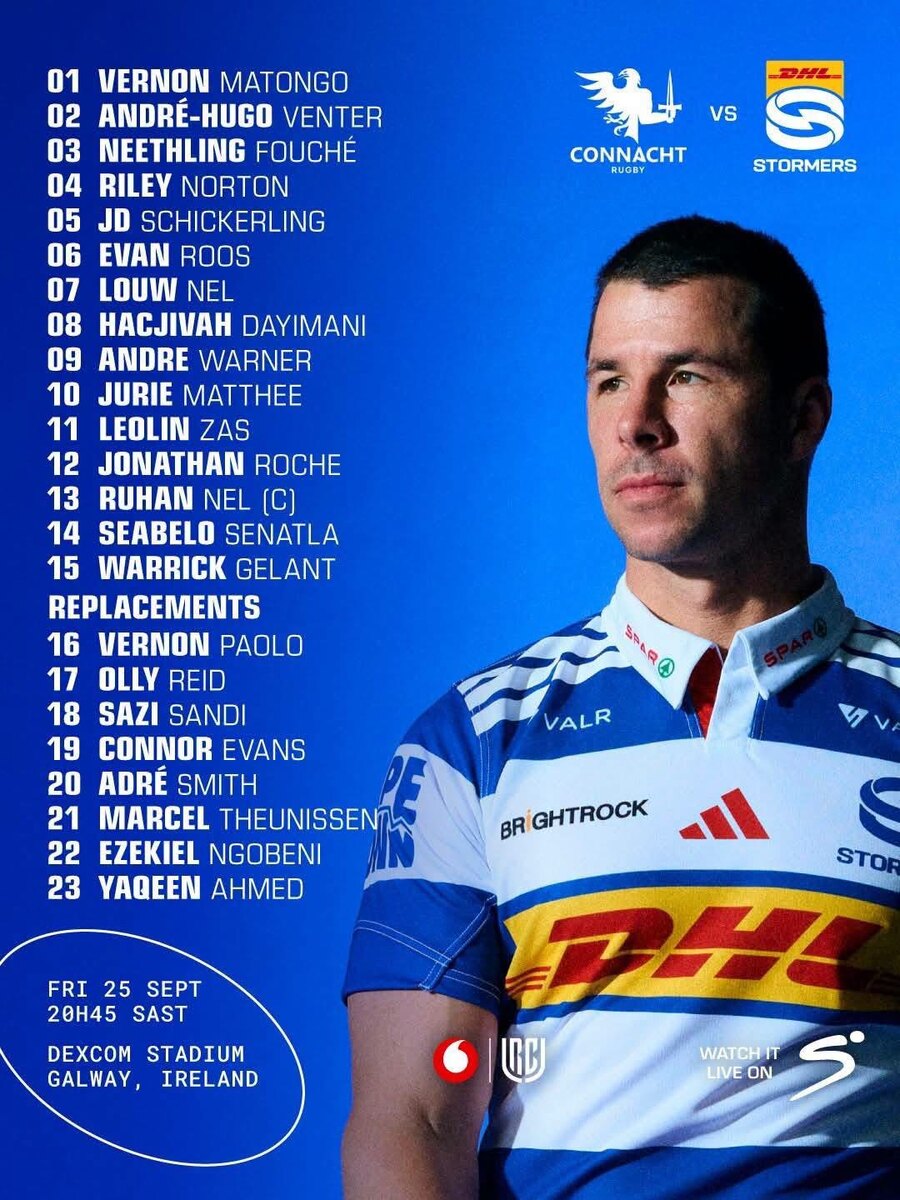
43.5%.
Already substantially ahead of the Bulls and Lions.
The Red Disa Consortium controls 74% of WP Professional Rugby. John Dobson is director of rugby, and the coaching department identified in our research includes Rito Hlungwani, Labeeb Levy, Riefaat Jappie, Dawie Snyman, Norman Laker, Brok Harris and Gareth Wright.
It is visibly more diverse than some of the other senior structures.
But here’s the receipt that matters more.
Western Province publicly made transformation within coaching and management part of Dobson’s responsibility in 2019.
So seven years later, this isn’t an unfair question:
What has changed — and has it changed fast enough?
The Stormers are ahead of two of their domestic competitors in this snapshot. That deserves acknowledgement.
But transformation was an explicit institutional responsibility.
So measure it.
THE SHARKS: 12 OUT OF 23
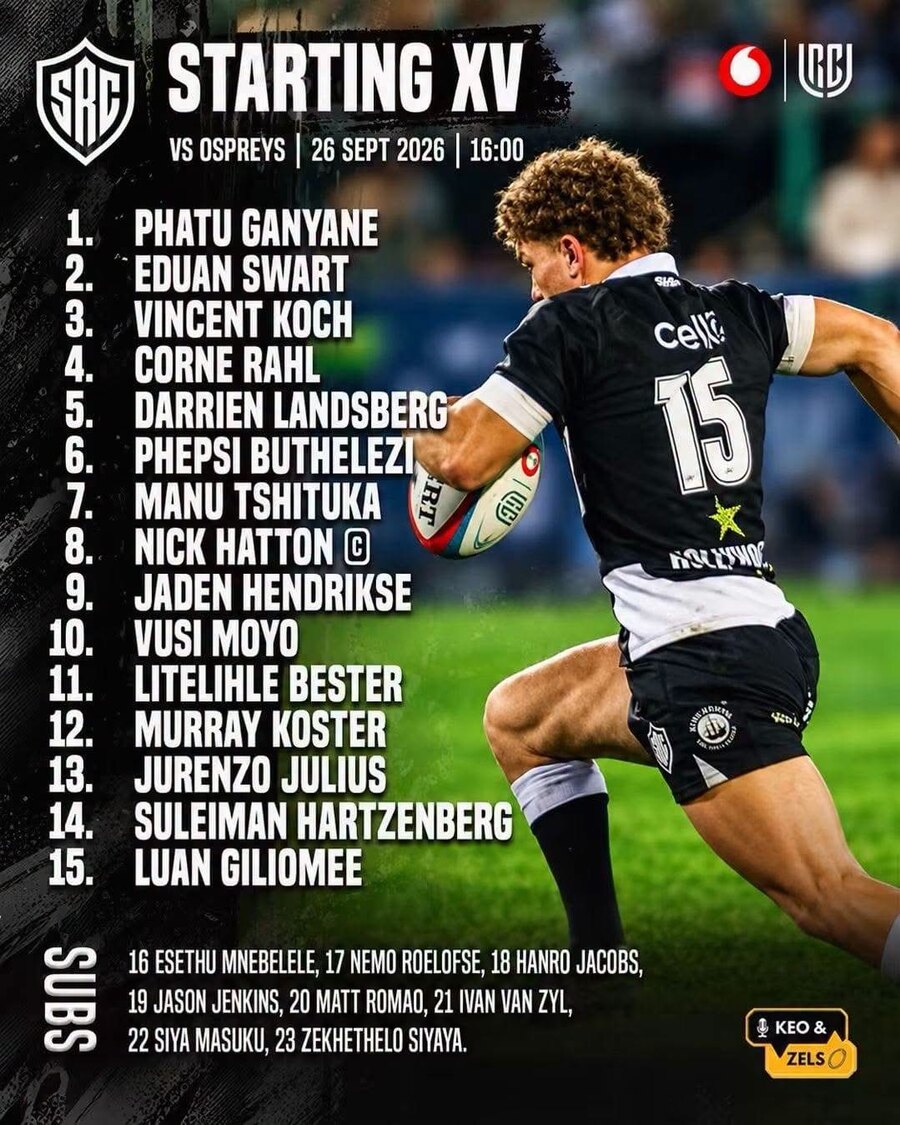
Now we arrive at the highest number.
12 of 23 — 52.2%.
JP Pietersen is head coach and is documented as a person of colour.
That’s all we need here.
Because the interesting part isn’t spending 800 words debating JP Pietersen’s identity.
It’s what his rugby organisation produced.
The Sharks had the highest representation among the four teams in our snapshot, and their junior pathway has an unusually identifiable chain of responsibility.
Neil Powell’s remit covers the Sharks Academy, U20 programme, junior staff, talent identification and development.
Good.
Someone owns the pathway.
And the result this weekend was 52.2%, compared with 30.4% at the Bulls and 26.1% at the Lions.
Same national rugby ecosystem. Same competition. Very different outcomes.
That does not establish that Pietersen’s identity caused the Sharks’ higher representation.
But the contrast absolutely deserves investigation.
Why are these professional systems producing such different results?
NOW LET’S TALK ABOUT “MERIT”
This word is going to appear underneath this article approximately 700 times.
MERIT.
Fine.
Let’s talk about it.
Professional rugby should select elite players. The Springboks should select the best possible team. Nobody should receive a jersey because of their race.
But there is an important distinction between: WHO IS THE BEST PLAYER TODAY? and: WHO HAD THE OPPORTUNITY TO BECOME THE BEST PLAYER?
Merit is assessed at the point of selection. Opportunity is distributed long before it.
A teenager doesn’t award himself an academy contract. He doesn’t scout himself, provide his own accommodation or select himself at U20 level. He doesn’t decide how many minutes he receives, whether a poor season earns patience or release, or whether coaches see him as “raw”, “high potential”, “not ready” or “the future”.
People make those decisions.
And those decisions compound.
A decision at 16 affects the opportunities available at 18. Decisions at 18 shape development at 20. By 22, years of accumulated opportunity — or its absence — may already separate an established professional from somebody who disappeared from the elite pathway.
By the time the Springbok coach sits down to pick 23 players, thousands of development decisions have already influenced who is available.
So saying: “Pick on merit.” doesn’t end this conversation.
Merit matters enormously.
But the intellectually serious question is: How was the pool of merit produced?
Or, more simply: Now tell us how merit was developed.
SA RUGBY’S OWN AUDIT ALREADY UNDERSTANDS THIS
This isn’t ScrumAtMe inventing a theory.
SA Rugby’s transformation audit did not look exclusively at the Springboks. It measured the broader rugby ecosystem — provinces and pathways through to the national team — precisely because transformation at the top cannot be separated from what happens underneath.
And SA Rugby president Mark Alexander pushed back in 2024 against treating the Springbok numbers alone as the whole transformation story, arguing that progress had to be understood more broadly.
Fine.
We agree.
So let’s look broadly.
Don’t show us only the Springboks. Show us the franchises.
Don’t show us only the franchises. Show us the academies.
Then show us recruitment, contracts, retention, coaching, management and ownership.
Show us the road.
BECAUSE THE ROAD ENDS IN GREEN AND GOLD
That’s why this matters.
If the Bulls, Lions, Stormers and Sharks do not develop deep pools of elite Black African players, the national system eventually inherits that shortage.
And the 2023 Springbok numbers show why the question matters.
The Black African target was 27%.
During the Rugby Championship, representation was 13%.
At the World Cup, it was 16%.
Now look back down the pyramid at our current URC snapshot:
20.7% Black African.
Those are not directly comparable measurements — one is a weekend snapshot and the other covers Springbok competition usage — so don’t pretend they’re the same dataset.
But they are absolutely part of the same rugby pipeline.
And they point towards the same question:
WHERE ARE THE PLAYERS BEING LOST?
If the pipeline has already narrowed before players become internationally selectable, screaming at the Springbok coach afterwards doesn’t rebuild it.
It simply argues about the final output.
THIS IS WHERE “NATURAL SELECTION” FALLS APART
Nature didn’t choose which schools received elite rugby infrastructure or which academies received the resources to develop talent. Nature didn’t scout the players, offer the contracts or appoint the coaches.
It didn’t determine who played U20 rugby, who received specialist coaching, who was retained, who accumulated 50 professional matches or who eventually became Springbok-ready.
People did. Institutions did. South African rugby did.
That doesn’t automatically make the outcome racist.
But it establishes something important: the outcome isn’t simply natural.
Professional rugby is an organised system in which human institutions construct the environment, distribute opportunities and then select from the population that survives that process.
Calling the final outcome “natural selection” therefore risks treating the result as spontaneous while ignoring the machinery that produced it.
SO IS IT RACISM?
The numbers alone cannot answer that.
They cannot tell us the motive inside somebody’s head, and they cannot establish that three white coaches deliberately discriminate against Black players.
They don’t need to.
Because that is not the only serious question available.
Here’s the harder one:
Can a system produce racially unequal outcomes without every individual inside it consciously deciding to discriminate?
That is a much more significant question than whether one coach is personally racist.
The larger investigation is into opportunity: how it is distributed, when it is distributed, who controls it, how long players receive it and what happens to those who do not.
South African rugby’s history makes those questions impossible to dismiss. But history alone cannot explain a contemporary professional system either.
The modern institutions have to be examined on their own evidence.
81.7%.
Come back to the beginning.
81.7% of South Africa is Black African.
In our four URC team sheets: 20.7% of the players were Black African.
Nobody should expect those two percentages automatically to match.
But nobody serious should look at the distance between them and decide there’s nothing worth investigating.
Especially when SA Rugby has transformation targets, the Springboks have previously missed them, the franchises have historically produced materially different transformation outcomes, three of four top domestic rugby positions are held by white coaches, and the professional organisations themselves control large parts of the pathway producing the players ultimately available for selection.
Those aren’t accusations.
Those are facts.
And facts that persist across different levels of the same system require explanations stronger than: That’s just who was available.
THE QUESTION ISN’T WHETHER WE WANT WEAKER SPRINGBOKS
Absolutely not.
We want the opposite.
Imagine South African rugby genuinely accessing, developing and retaining the best rugby talent available across the entire country.
South Africa already wins World Cups. It already produces freak athletes, produces props like factories and exports professional rugby players around the world.
And it may still not be extracting everything available from the overwhelming majority of its population.
THAT should scare world rugby.
Because transformation done properly should not mean lowering the standard.
It should mean making the pool from which that standard is selected enormous.
The competitive argument for transformation is therefore not merely moral or demographic. It is also brutally sporting: a system capable of identifying and developing elite talent from a larger proportion of 63 million people should, in principle, create more competition, more depth and more exceptional players.
South Africa doesn’t need weaker Springboks.
It needs more Springboks.
DON’T LOWER THE BAR. BUILD THE ROAD.
Scout wider. Develop earlier. Fund properly. Create elite coaches and open credible pathways.
Track academy demographics, retention, professional minutes and releases. Track who receives second chances. Track who becomes professional and who becomes a realistic Springbok candidate.
Then: PICK THE BEST.
That’s the rugby answer.
Because the objective should never be to manipulate the final 23 until the numbers look better.
The objective should be to build a system capable of producing a much larger pool of players genuinely good enough to compete for those 23 places.
DON’T GIVE HIM THE SPRINGBOK JERSEY. GIVE HIM THE ROAD TO EARN IT.
If South African rugby builds that road properly, eventually the transformation argument changes completely.
The coach doesn’t need to manufacture a percentage. The player doesn’t have to wonder whether people think he was selected because of his race. Supporters don’t have to argue endlessly about whether transformation weakened the team.
You simply have more world-class South African rugby players competing for the same jersey.
That’s the destination.
But we’re not there yet.
The numbers say we’re not.
SO WE’LL ASK IT ONE LAST TIME.
IS IT RACISM?
Or is it natural selection?
Maybe the answer isn’t sitting neatly at either extreme.
Maybe it is buried somewhere across schools, academies, money, history, geography, recruitment, contracts, coaching, ownership and opportunity — and in thousands of human decisions made years before anybody sees a Springbok team sheet.
But one thing should be clear after opening these files:
“Natural selection” cannot be the end of the explanation when institutions control the environment in which selection occurs.
The Bulls have questions to answer.
The Lions have questions to answer.
The Stormers have questions to answer.
The Sharks should be studied too, because they are producing a noticeably different result.
And SA Rugby has questions to answer about how those four professional pathways eventually converge at the national team.
Because ultimately this isn’t about forcing somebody into a jersey.
It is about understanding the architecture of opportunity that determines who ever becomes capable of competing for that jersey.
That is the bigger question beneath all these numbers:
WHO GETS THE ROAD TO BECOME GOOD ENOUGH TO EARN IT?
Those are the numbers.
Those are the systems.
Those are the decision-makers.
Reader decides.
CAMERAS OFF. TALK.
ScrumAtMe — Comedic Technical Analysts.
Real facts. Wild jokes.