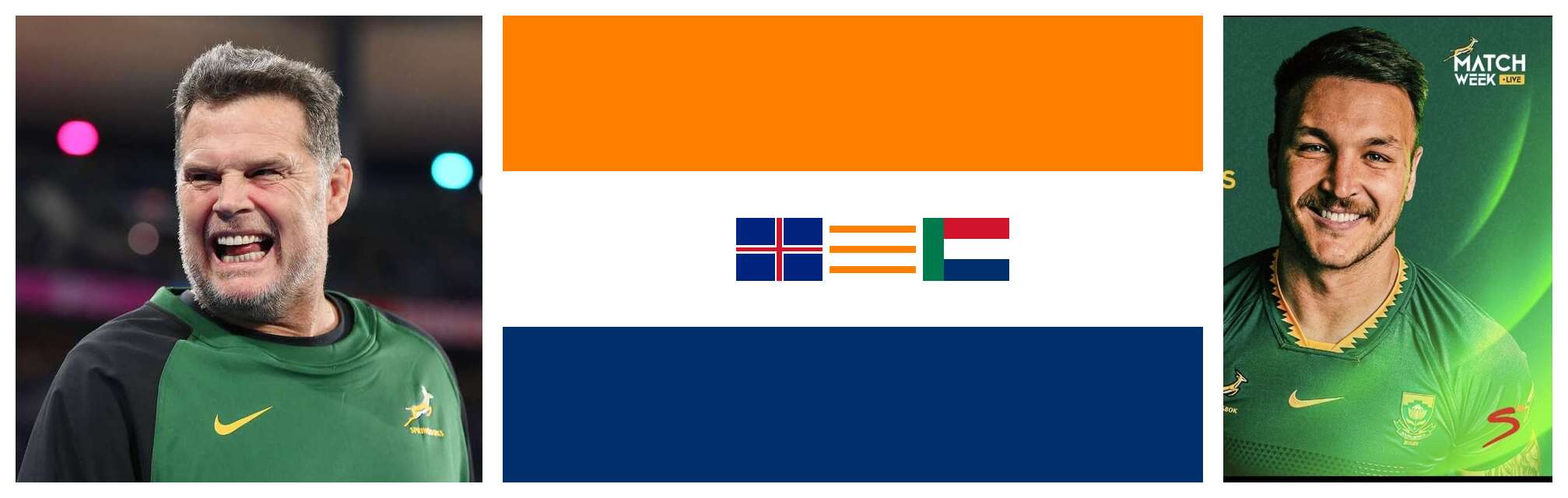
There are stories where the headline needs help.
This is not one of them.
André Esterhuizen is going to captain South Africa.
Not simply play for South Africa. Not return from suspension. Not earn another cap.
Captain South Africa.
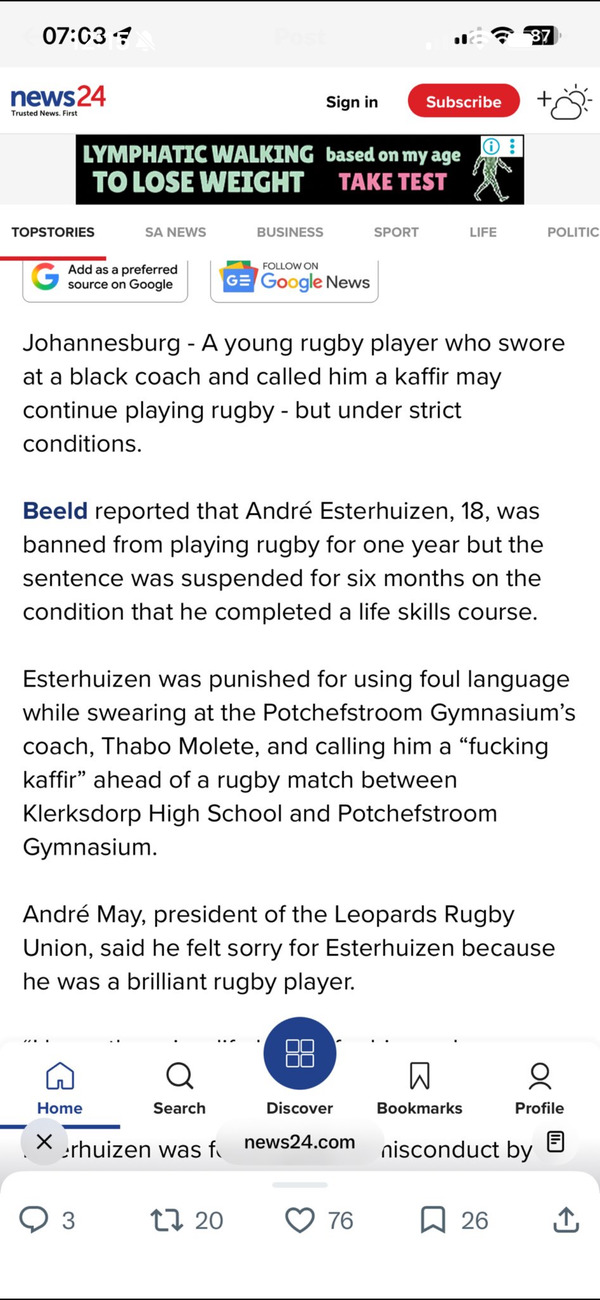
And the same André Esterhuizen was, at 18 years old, found guilty of misconduct after racially abusing black rugby coach Thabo Molete in 2012.
That isn't internet archaeology dressed up as journalism. It isn't mistaken identity. And it isn't an allegation invented fourteen years later because Esterhuizen has suddenly become news.
The disciplinary case was reported contemporaneously on 4 July 2012 by News24 and Rugby365. News24 reported that Esterhuizen swore at Molete and called him a “fucking kaffir.”
Fourteen years later, Rassie Erasmus has handed him the armband of the country he represents.
Nahhh, Unc.
We're going to have to open the files.
FIRST, THE PART NOBODY GETS TO ARGUE AWAY
In 2012, Esterhuizen was an 18-year-old outside centre at Klerksdorp High School.
The incident involved Thabo Molete, then coach of Potchefstroom Gimnasium's first XV. Rugby365 also identified Molete as coach of the Leopards Grant Khomo side and a rugby organiser at the school.
The Leopards Rugby Union convened an independent disciplinary committee.
According to Rugby365, it consisted of advocate Johan Pretorius, union legal adviser Johan le Grange and deputy president Makwezi Best.
And here's where the language matters.
Esterhuizen wasn't merely accused on Twitter.
News24 reported that he was found guilty of misconduct by the disciplinary hearing.
The consequences were real.
He was handed a one-year rugby ban, reported as suspended for six months subject to completing a life-skills course, and he lost his place in the Leopards Craven Week team. Rugby365 independently reported the same core disciplinary outcome.
Leopards president André May described Esterhuizen at the time as a brilliant rugby player and said he hoped there would be a life lesson in the episode.
And perhaps there was.
That's actually one of the most important questions in this entire story.
We don't know.
WHERE IS THABO MOLETE IN THIS STORY?
This is where the historical record becomes uncomfortable for a different reason.
Read the surviving reports and watch what happens.
The promising rugby player's punishment is documented.
His Craven Week selection is documented.
His talent is discussed.
His future is discussed.
His rehabilitation is discussed.
But what about the black coach who actually received the racial abuse?
Thabo Molete almost disappears.
The contemporary reports we located identify him, his position and the abuse directed toward him, but they don't give us a meaningful account of what the incident did to him or how he regarded the eventual punishment.
And fourteen years later, that's where this story gets bigger than one ugly sentence uttered by an 18-year-old.
Because South African rugby isn't merely selecting Esterhuizen again.
It is making him captain.
Those are not equivalent honours.
THE SPRINGBOK CAPTAINCY ISN'T JUST ANOTHER JERSEY
We need to show some intellectual honesty here.
People can change.
Fourteen years is a long time.
An 18-year-old is not frozen forever as the worst thing he did at 18.
Rehabilitation is a legitimate idea. Growth is a legitimate idea. Redemption is a legitimate idea.
But redemption requires a story.
And that's the story we cannot find.
Where is Esterhuizen publicly acknowledging what he did?
Where is the apology to Molete?
Where is the explanation of what the life-skills intervention taught him?
Where is the account of reconciliation?
Where is Molete?
Where is the conversation about what it means that a teenager disciplined for racial abuse has now matured into someone South African rugby considers worthy of representing the entire country as captain?
Maybe those conversations happened privately.
Maybe Esterhuizen apologised privately.
Maybe Molete forgave him years ago.
Maybe Esterhuizen has spent fourteen years becoming a completely different man.
Those possibilities matter. But they are not facts we can invent.
In the public material we reviewed, we could not establish a public apology to Molete, a public statement accepting responsibility for the incident, documentary confirmation of the required life-skills course's completion, or an account from Molete confirming reconciliation.
Absence of a public record does not prove those things never happened.
It means something much simpler:
We don't have the record.
And when you're making someone captain of South Africa, that missing chapter suddenly matters.
BECAUSE RASSIE DIDN'T HAVE TO DO THIS
This is another critical part of the story.
Esterhuizen did not become captain because there was nobody else.
Regular captain Siya Kolisi isn't in the matchday squad. But Eben Etzebeth is starting.
Etzebeth has previously captained South Africa.
Handré Pollard is starting.
Pollard has previously captained South Africa.
Rassie therefore made an affirmative leadership choice.
He chose Esterhuizen.
Erasmus explained yesterday that Esterhuizen's leadership of the Sharks through a difficult period impressed him. He praised how Esterhuizen has served the Springbok team, accepted roles at centre, flank and off the bench, and said the coaching staff wanted another leadership option available approaching the World Cup.
In fact, Erasmus explicitly acknowledged that they could simply have given the captaincy to Etzebeth again.
So let's remove one possible escape hatch immediately.
This wasn't forced.
It was a choice.
And that choice deserves scrutiny.
68TH SPRINGBOK CAPTAIN
On Sunday in Perth, Esterhuizen is scheduled to become the 68th player to captain South Africa.
He starts at inside centre in a team containing Etzebeth, Pollard, Franco Mostert, Marco van Staden and, from the bench, Malcolm Marx, Ox Nche, Lood de Jager and Jasper Wiese.
Think about what that armband represents.
This is a country where rugby and race cannot be separated from history simply because doing so makes the team sheet easier to discuss.
For generations, the Springbok jersey itself was entangled with apartheid.
Then came the extraordinary national symbolism of 1995.
Nelson Mandela.
Francois Pienaar.
That jersey.
That trophy.
That image.
And decades later, Siya Kolisi became the first black Test captain of the Springboks and ultimately lifted the World Cup twice.
So no:
captain of South Africa is not merely an administrative designation for who talks to the referee.
The office carries history.
Which is precisely why Esterhuizen's history deserves to be confronted rather than quietly detached from Sunday's announcement.
AND HERE'S WHERE SCRUMATME HAS TO BE CONSISTENT
We've already spent considerable time examining Springbok selection.
We've opened transformation numbers.
We've asked who gets opportunities.
We've asked what pathway produces the national team.
We've asked whether South African rugby's leadership reflects the country represented by the jersey.
So we're not going to suddenly develop amnesia because the conversation has become uncomfortable.
This isn't:
“André Esterhuizen did something racist at 18, therefore André Esterhuizen must forever be a racist.”
The documented finding concerns what he did. It does not give us a licence to declare what exists inside a 32-year-old man's mind fourteen years later.
That's cheap.
The harder question is far more interesting:
What does South African rugby require before someone with that history is entrusted with its highest leadership honours?
Time?
Good rugby?
Private rehabilitation?
A clean record?
An apology?
Reconciliation?
Acknowledgment?
Nothing?
That's the conversation.
Because if the answer is rehabilitation, excellent.
Show us the rehabilitation.
Not because a man should be publicly humiliated forever.
Because redemption is more powerful when somebody actually owns the thing from which they are supposedly redeemed.
AND WHAT ABOUT MOLETE?
This may be the question that matters most.
Before everyone races to discuss whether Esterhuizen deserves forgiveness, perhaps somebody should ask:
What does Thabo Molete think?
Does he believe Esterhuizen changed?
Did he receive an apology?
Did they ever speak?
Does he consider the matter finished?
How does he feel seeing the teenager who racially abused him become captain of the Springboks fourteen years later?
Those answers could transform this story.
Maybe Molete tells South Africa that Esterhuizen apologised sincerely years ago and he considers the matter closed.
That matters.
Maybe he says the opposite.
That matters too.
But somehow we've reached Springbok captaincy without his voice forming part of the public conversation.
The victim shouldn't become a footnote in somebody else's redemption arc.
THE WORD MATTERS
And we're not going to sanitise what happened into “controversial comments.”
We're not going to call it “an unfortunate incident.”
We're not going to write that Esterhuizen simply “used inappropriate language.”
South Africans know what the k-word is.
They know its history.
They know what it was designed to communicate.
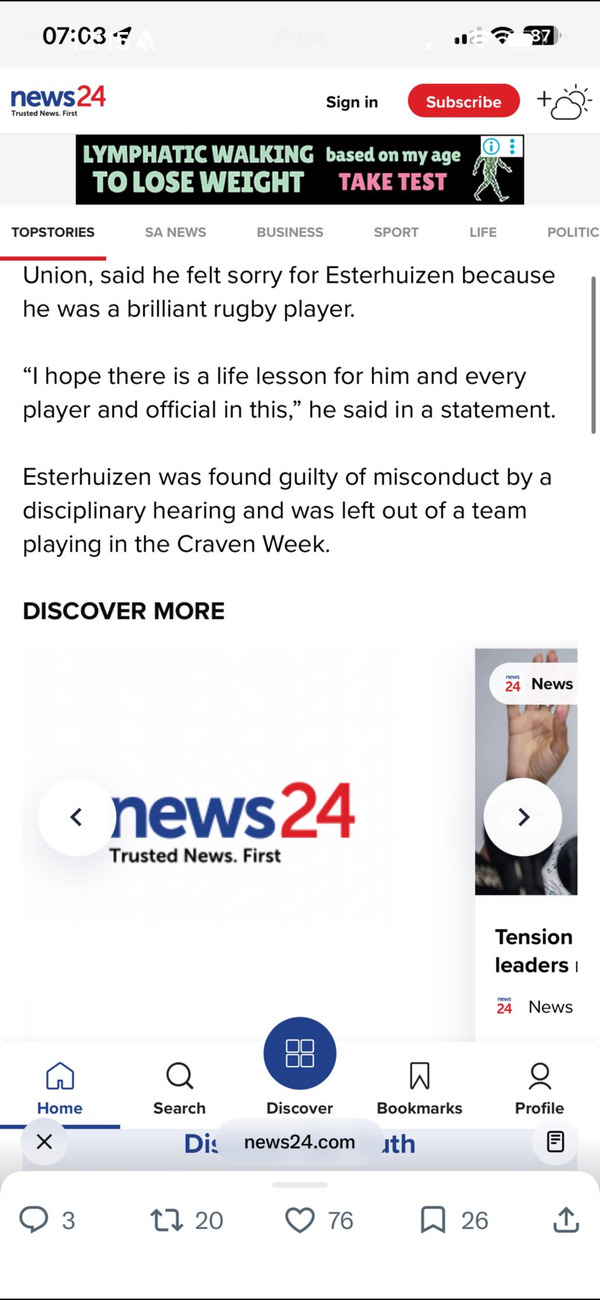
And contemporary reporting says Esterhuizen directed it at a black coach. A formal rugby disciplinary hearing followed, and News24 reported that Esterhuizen was found guilty of misconduct.
Those are the facts.
You don't need to inflate them.
They're serious enough already.
FOURTEEN YEARS LATER
And now comes the image that makes this story impossible to ignore.
The teenager disciplined after racially abusing Thabo Molete grew up.
He became a professional.
A Shark.
A Harlequin.
A Springbok.
A World Cup winner.
A senior international.
A Sharks captain.
And now:
Springbok captain.
That journey may ultimately be a story of extraordinary rehabilitation.
It may be a story about institutional forgetfulness.
It may contain elements of both.
We don't have enough evidence to decide that for Esterhuizen.
But South African rugby does have enough history to understand why the question cannot simply be ignored.
And that is where SA Rugby and the Springbok management have something worth explaining.
Was the 2012 disciplinary case considered before Esterhuizen was appointed captain?
Was the management satisfied that the matter had been properly addressed?
Did Esterhuizen complete the intervention imposed upon him?
Has he ever discussed the incident with the Springbok leadership?
Was there reconciliation with Molete?
And, perhaps most importantly:
What does André Esterhuizen himself say about it now?
Because fourteen years is enough time for a person to change.
It is also enough time to find the words.
CAMERAS OFF. TALK.
We can celebrate the Springboks and still ask difficult questions about them.
Actually, if that jersey means what South Africans say it means, we should demand difficult questions precisely because we care about it.
André Esterhuizen was found guilty of misconduct following racial abuse of Thabo Molete in 2012.
André Esterhuizen is scheduled to captain South Africa in 2026.
Both things are true.
The fourteen years between them are where the journalism starts.
So, Unc Rassie:
we opened the files.
Now somebody open the missing chapter.
What happened between the ban and the armband?
ScrumAtMe — Comedic Technical Analysts.
Real rugby news. Weaponised into comedy.