Scrum At Me · The Daily Scrum · 13 September 2026
There is a very important piece of rugby diplomacy we need to get out of the way before we begin.
Rassie Erasmus says the Springboks are not necessarily a better team than New Zealand.
Beautiful.
Respectful.
Very mature.
Very international rugby.
Fortunately, Rassie does not write The Daily Scrum.
Because the scoreboard has spent the last three Tests behaving with considerably less diplomacy.
33–26.
29–24.
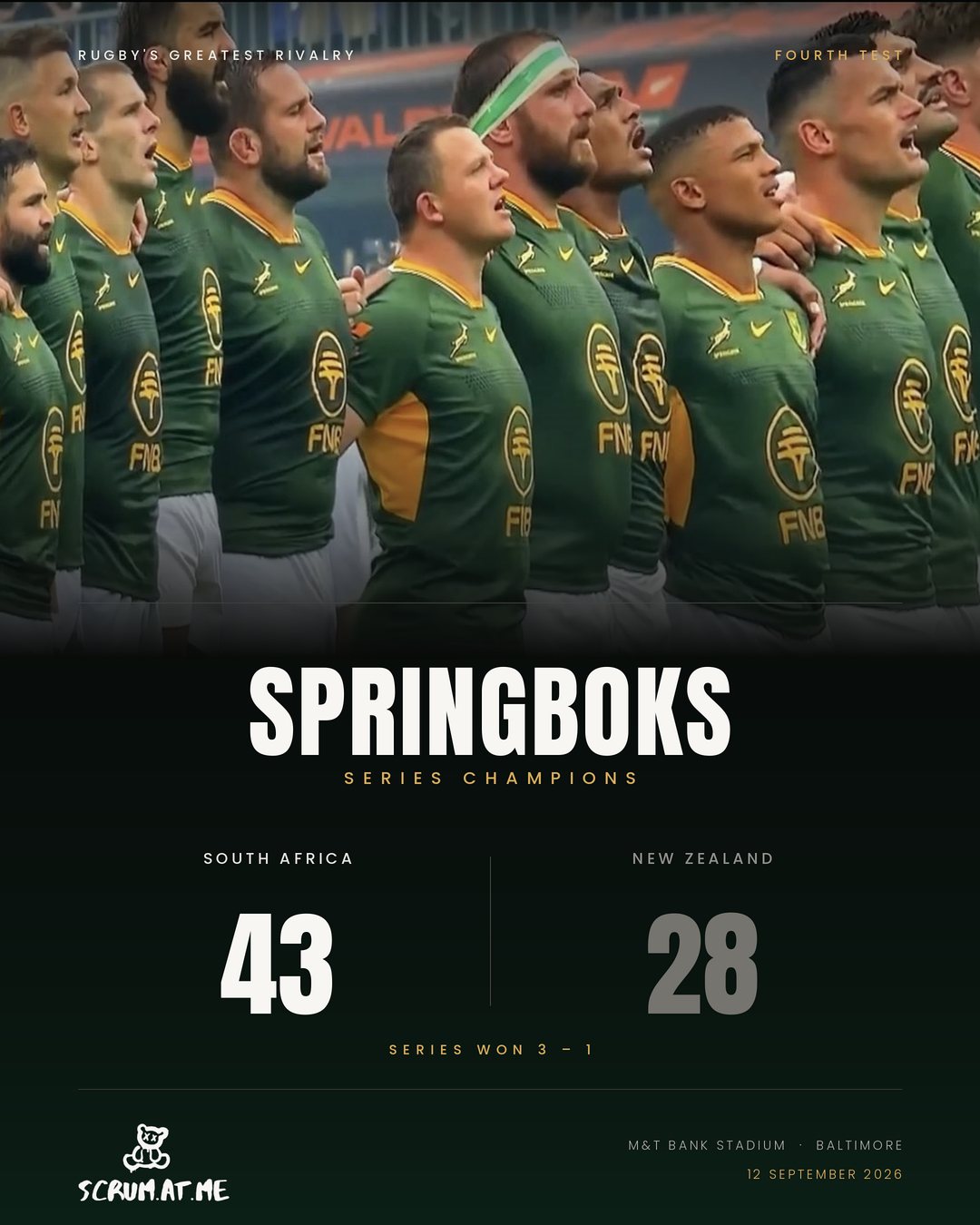
43–28.
Three consecutive Springbok victories.
Six tries in Baltimore.
A 3–1 series victory.
The first traditional bilateral Test-series win over New Zealand since South Africa beat them 3–1 in 1976.
And perhaps the funniest part of this entire story?
The All Blacks actually won the first Test.
By 17 points.
Nahhh mayne.
New Zealand arrived at Ellis Park, beat South Africa 33–16, scored five tries to one and briefly had the rugby world preparing its favourite funeral again.
The Springboks are finished.
Rassie has been figured out.
The experimentation has gone too far.
The All Blacks are back.
Facebook Unc had already opened the comments.
Three Tests later South Africa were standing in Baltimore, Maryland, holding the trophy after beating New Zealand 43–28 in front of 68,173 people.
From 0–1 down.
To 3–1 up.
That’s not a comeback.
That’s four weeks of evidence.
FIRST, LET’S TALK ABOUT WHAT ACTUALLY HAPPENED IN BALTIMORE
This was not 80 minutes of South Africa sitting on New Zealand’s chest.
And saying it was would actually make the real story less impressive.
The All Blacks fought.
Hard.
They scored four tries.
They were only three points behind at halftime, 17–14.
They were still alive at 29–21 deep into the second half.
Rassie himself admitted afterwards that he still felt the match — and effectively the series — remained in the balance approaching the final ten minutes.
Then Kurt-Lee Arendse found grass.
And that was that.
South Africa turned 29–21 into 43–21 in approximately four minutes.
Arendse first.
Cameron Hanekom next.
Beauden Barrett’s converted try at the death made the final score 43–28, but by then the trophy had effectively already been packed into the Bok changing room.
So when we say the Boks destroyed New Zealand, understand what we mean.
Not every minute.
The minutes that mattered.
And championship teams don’t necessarily dominate every minute.
They dominate the minutes that decide who takes the trophy home.
THE ALL BLACKS LANDED THE FIRST PUNCH

New Zealand actually started well.
Sacha Feinberg-Mngomezulu put South Africa ahead with an early penalty, but the All Blacks answered through Codie Taylor.
Quick hands.
Damian McKenzie involved.
Cam Roigard stretching the defence.
Taylor over.
And that try carried its own piece of history: his 24th Test try, moving him beyond Dane Coles as the All Blacks’ leading try-scoring hooker.
New Zealand looked sharp.
Then Damian de Allende basically said:
Okay, enough of that.
South Africa worked through ten phases inside the New Zealand 22.
Not kick-and-pray.
Not waiting for a scrum penalty.
Carries.
Recycling.
Gain line.
Again.
Again.
Again.
Then De Allende punched through from close range.
10–7.
This matters because we’ve spent years listening to people explain Springbok rugby to South Africans as though the Boks possess only three buttons:
SCRUM.
MAUL.
KICK.
Meanwhile South Africa would eventually score six tries through six different players in Baltimore.
But we’ll get to that.
THEN MORNÉ VAN DEN BERG STARTED HAVING FUN
There had already been disruption because of a communications problem involving the match officials.
Eventually South Africa kicked into the corner.
New Zealand prepared for the obvious.
Big South African forwards.
Lineout.
Maul.
Violence.
Simple.
Except Morné van den Berg looked at the fringe defence, realised the All Blacks had become a little too interested in the meat department and simply went himself.
Dummy.
Gap.
Goodnight.
17–7.
And that little moment tells you why Van den Berg was eventually named Player of the Match.
He was not simply moving the ball away from rucks.
He was asking questions.
Constantly.
Where’s your guard?
Who is watching the nine?
Are your forwards folding?
Can I accelerate before your defence resets?
And whenever New Zealand got the answer wrong, he punished them.
Later, he would also have a major hand in the attack that produced Pieter-Steph du Toit’s try.
This wasn’t simply a good scrumhalf performance.
It changed South Africa’s speed.
AND THEN NEW ZEALAND REMINDED EVERYBODY WHO THEY ARE
This is the bit we refuse to erase because we’re pro-Bok.
New Zealand are still New Zealand.
Before halftime they constructed a 32-phase possession.
Thirty-two.
South Africa defended.
Reset.
Defended.
Reset.
And eventually Will Jordan appeared underneath the posts for his 55th Test try, extending his New Zealand record.
17–14.
Now we’ve got a Test match.
And if you’re South African, you know exactly what happened next.
You looked at the bench.
THE BOMB SQUAD CLOCKED IN
Early second half.
Fresh Springbok forwards.
Scrum pressure.
Penalty.
Corner.
Lineout.
Maul.
Malcolm Marx.
Try.
Then almost immediately New Zealand made an error from the restart.
Another scrum.
Another platform.
Feinberg-Mngomezulu attacks the space.
Van den Berg breaks through.
Pieter-Steph du Toit arrives.
Try.
In roughly three minutes the scoreboard went from:
17–14
to
29–14.
That’s what the Bomb Squad does when it’s functioning properly.
It doesn’t merely “provide impact.”
That’s corporate rugby language.
It changes the physics of the match.
Suddenly the scrum moves differently.
The collisions feel different.
The defensive line has to get up again against men who have been sitting down watching you get tired.
And now your clearing kick isn’t coming from halfway.
It’s coming from behind your own posts.
Reuters identified South Africa’s early replacement impact and resulting scrum pressure as a key catalyst in that second-half surge.
BUT THE ALL BLACKS DIDN’T DIE
Ethan Blackadder scored.
New Zealand cut it to 29–21.
Blackadder also finished with 21 tackles, the highest published figure from the match analysis, while making his first start of the series.
This is why the result deserves more respect than pretending the All Blacks were rubbish.
They weren’t.
They kept finding ways back into the contest.
That is what makes what happened next so damaging.
Because at 29–21, they had hope.
They were attacking.
They were within one converted try and change.
Then a loose ball appeared.
And unfortunately for New Zealand, the man standing near it was Kurt-Lee Arendse.
KURT-LEE SAID: THANK YOU VERY MUCH
Arendse picked it up.
Looked up.
And left.
Roughly 70 metres later, New Zealand’s comeback had become a cardio exercise.
Rassie later identified it as the turning point.
His description was better than anything we could invent:
Kurt-Lee started “burning guys.”
Correct.
There are sophisticated tactical explanations available.
Transition defence.
Broken-field spacing.
Support alignment.
Poor kick chase.
Whatever.
Our technical analysis is:
HE STARTED BURNING GUYS.
Arendse’s try made the score 36–21.
Four minutes later Hanekom scored.
43–21.
Match.
Series.
Argument finished.
Barrett’s late converted try moved New Zealand to 28 and, for statistical accuracy, Damian McKenzie converted all four All Blacks tries.
Four tries.
Four conversions.
28 points.
No mystery maths required.
SIX TRIES. SIX DIFFERENT BOKS.
Now we have to address something because we know someone somewhere is already typing:
“BUT SOUTH AFRICA ONLY WIN WITH SCRUMS.”
Okay Unc.
South Africa’s six try scorers in Baltimore were:
Damian de Allende — centre
Morné van den Berg — scrumhalf
Malcolm Marx — hooker
Pieter-Steph du Toit — flanker
Kurt-Lee Arendse — wing
Cameron Hanekom — replacement loose forward
Six tries.
Six scorers.
Different positions.
Different methods.
Phase attack.
Fringe deception.
Driving maul.
Broken field.
Transition.
Power.
Speed.
But please continue explaining how the Springboks only know how to scrum.
We’ll wait.
AND YES, THE BOKS ABSOLUTELY WON THE COLLISIONS
Here is where the numbers become violent.
According to RugbyPass’s published figures, South Africa registered 142 carries to New Zealand’s 136 and generated 539 post-contact metres to New Zealand’s 362.
That is a 177-metre difference after contact.
After contact.
Meaning the important number is not merely where the carrier receives the ball.
It’s what happens after a New Zealand defender arrives.
Damian de Allende reportedly carried 18 times.
Jasper Wiese 17.
Pieter-Steph scored and spent another evening treating collision areas like personal disagreements.
Those figures reinforce what the eye told us.
The Boks didn’t just possess the ball.
They kept moving the point of contact.
And when a team repeatedly wins another half-metre, then another metre, then two more metres, the defence eventually stops looking organised and starts looking exhausted.
NOW ZOOM OUT.
Because Baltimore alone isn’t actually the biggest story.
The series is.
Test One: Ellis Park
New Zealand 33–16 South Africa.
Five tries to one.
Boks beaten.
Late cards.
Thirteen men finishing.
New Zealand 1–0.
Test Two: Cape Town
South Africa 33–26 New Zealand.
Boks answer immediately.
Series 1–1.
Test Three: Soweto
South Africa 29–24 New Zealand.
Siya Kolisi records his 55th victory as Springbok captain.
South Africa 2–1.
Test Four: Baltimore
South Africa 43–28 New Zealand.
Six tries.
South Africa 3–1.
And that’s when the numbers become properly nasty.
Across all four Tests:
South Africa 121.
New Zealand 111.
Only ten points across the complete series.
Which tells you how damaging that Ellis Park loss was to the aggregate.
But across the three Tests South Africa actually won?
Springboks 105.
All Blacks 78.
That’s +27 over three consecutive victories.
And compare the first Test to the last:
Ellis Park: Boks lose by 17.
Baltimore: Boks win by 15.
That’s a 32-point turnaround.
Not across generations.
Not across different coaches.
Across the same series.
THAT IS THE REAL RASSIE STORY
Rassie’s teams have always been associated with preparation.
But this series showed something even more dangerous.
Correction speed.
The Boks got punched in the mouth in Test One.
They didn’t spend three months publishing strategic reviews.
They had seven days.
And they answered.
Then seven days later they answered again.
Then Baltimore.
Answered again.
South Africa were never beaten twice consecutively in the series.
That’s important because Test rugby at this level is not about producing one perfect tactical plan and framing it on a wall.
New Zealand adjust.
You adjust to their adjustment.
They change personnel.
You change shape.
They find your edge.
You find theirs.
Four-Test series rugby exposes coaches because eventually everybody knows what everybody is trying to do.
There are fewer secrets by Test Four.
And when there are fewer secrets, execution becomes king.
New Zealand knew South Africa’s physicality was coming.
They knew the replacement forwards were coming.
They knew the scrum pressure was coming.
They knew Arendse was dangerous.
They knew De Allende was going to carry.
Knowing did not stop it.
That’s the difference.
RASSIE’S 100TH TEST, BY THE WAY
Because apparently winning a four-Test series against the All Blacks wasn’t enough subplot for one night.
Baltimore was also reported as Rassie Erasmus’ 100th Test in charge of the Springboks.
One hundred.
And after South Africa finished New Zealand 43–28, what did Rassie do?
Did he call the Boks unquestionably superior?
No.
Of course not.
He said:
“I wouldn’t say we are a better team… we came out winners because we had more points on the board.”
Then he warned that the margin between these teams isn’t as large as the scoreboard might suggest.
That’s coach language.
That’s respect.
That’s Rassie ensuring nobody walks into the next camp believing the All Blacks have suddenly become Namibia.
We respect it.
But again:
Rassie is paid to manage the Springboks.
We are paid to look at the fucking numbers.
Three straight wins.
105–78 across those wins.
Six tries in the finale.
A 32-point turnaround from the opening Test.
Rassie can be diplomatic.
The scoreboard has no diplomatic passport.
SIYA’S MESSAGE WAS BIGGER THAN THE TROPHY

And this part matters.
Because Baltimore wasn’t just a neutral-site cash grab with nice graphics.
It was the first South Africa–New Zealand Test played in the United States.
68,173 people walked into M&T Bank Stadium.
That was reported as the largest crowd for a rugby-union match staged in the United States.
Siya Kolisi didn’t walk away talking only about beating the All Blacks.
He talked about people.
Where the Springboks come from.
What representing South Africa means.
And he thanked America for embracing South African culture.
Then, because apparently Siya cannot arrive in a country without starting a cultural exchange programme, the man is outside singing Gwijo in America.
Yesterday Baltimore thought it was hosting a rugby match.
By the end of the weekend they’ve got 68,000 people, six Bok tries and South Africans singing in the United States.
That’s how you grow the sport.
Not with PowerPoint.
With moments.
AND DON’T IGNORE WHAT THIS TOUR WAS TRYING TO DO
This wasn’t an ordinary four-Test window.
Rugby’s Greatest Rivalry was an attempt to bring back something professional rugby has largely lost:
the proper tour.
Weeks together.
Midweek matches.
Club opposition.
Four Tests.
A story that develops instead of disappearing after Saturday.
The All Blacks played eight matches across six weeks, including fixtures against South African franchises before the Test series.
And what happened?
People cared.
The rivalry had chapters.
Ellis Park mattered because Cape Town was coming.
Cape Town mattered because Soweto was next.
Soweto created Baltimore.
Baltimore finished the story.
The format is expected to reverse in 2030, when South Africa tours New Zealand.
Good.
Do it again.
Immediately.
Actually don’t wait until 2030.
Call somebody.
THE COMMERCIAL STORY? CAREFUL.
There have been some very large numbers thrown around about what Baltimore generated financially.
Published estimates do not all describe the same thing.
Some reporting has put the figure around £5 million per union.
Other reporting has referred to roughly R129 million in additional revenue shared between the unions.
Other estimates have floated approximately R80–100 million without always clearly distinguishing gross revenue, profit, or each union’s share.
So we’re not going to make up an audited bank statement because the number looks sexy.
What we can say confidently is this:
68,173 people watched South Africa and New Zealand play rugby in an NFL stadium in Baltimore.
Ahead of a 2031 Rugby World Cup in the United States, that matters enormously.
The experiment wasn’t merely sporting.
It was market research with tackles.
THEN THERE’S THE HISTORY
South Africa’s last traditional bilateral Test-series victory over New Zealand?
1976.
Score?
3–1.
Fifty years later?
3–1.
There is a qualification here because the Boks also beat New Zealand three times in the 2009 Tri Nations.
But that was a competition structure, not the same traditional bilateral Test-series format revived here.
So this is the clean historical line:
South Africa have won their first traditional bilateral Test series against New Zealand since 1976.
Half a century.
And when you place this series alongside the modern Bok–All Black record, the picture becomes uncomfortable for New Zealand.
South Africa have now won eight of the last ten Tests between the countries.
They beat New Zealand in the 2023 World Cup final.
They inflicted the All Blacks’ then-record 35–7 defeat in 2023.
They hit them 43–10 in 2025.
And now:
3–1.
At some stage this stops being a run of isolated results.
It becomes an era.
DON’T GET COMFORTABLE, THOUGH
And this is the part nobody wearing green wants to hear after a victory.
New Zealand are not dead.
Not even close.
They scored four tries in Baltimore.
They produced that ridiculous 32-phase sequence.
They had South Africa under pressure at 29–21.
Across the series they continued generating attacking opportunities.
They remain athletic enough, skilful enough and historically dangerous enough to punish any team that mistakes current superiority for permanent ownership.
That’s why Rassie refuses to call the gap huge.
Because the next All Blacks coach, player or analyst doesn’t care about your celebratory montage.
They’ll spend the next four years studying it.
And in 2030, South Africa has to go there.
That’s why this rivalry is rugby’s greatest rivalry.
There is no permanent victory.
Only the next Test.
BUT TODAY?

Today we’re not preparing the 2030 opposition analysis.
Today we’re enjoying the scoreboard.
Because South Africa went:
0–1.
Then:
1–1.
Then:
2–1.
Then:
3–1.
They absorbed New Zealand’s best opening punch.
Adjusted.
Beat them in Cape Town.
Beat them in Soweto.
Then flew to America and scored 43 points.
Six tries.
No card drama.
Player of the Match at nine.
Bomb Squad doing Bomb Squad things.
Kurt-Lee running away from people.
Siya singing Gwijo afterwards.
Rassie’s 100th.
68,173 people watching.
Trophy secured.
Mayne.
What exactly would you like us to complain about?
THE DAILY SCRUM VERDICT
Were the All Blacks competitive in Baltimore?
Yes.
Was this an 80-minute demolition?
No.
Did New Zealand still have a real shot at 29–21?
Absolutely.
And then what happened?
South Africa finished them.
That’s the point.
Champions don’t have to dominate every second.
They have to understand which seconds decide championships.
South Africa did.
Again.
Did New Zealand win Test One?
Yes.
Did South Africa lose another match after that?
No.
Did the Boks win three consecutive Tests?
Yes.
Did they win the series 3–1?
Yes.
Did South Africa score six tries in the finale?
YES.
Did the Springboks just win their first traditional Test series over New Zealand in half a century?
YES.
So we can perform all the diplomatic gymnastics we want.
We can talk about narrow margins.
We can remind everybody how good New Zealand remain.
We can correctly explain that Baltimore was still alive with ten minutes remaining.
All true.
Then we’re still going to walk back to the same scoreboard.
43–28.
And the same series score.
3–1.
New Zealand won the opening argument.
South Africa took the next three answers.
The series.
The trophy.
The American crowd.
And the final word.
Cameras off.
Rassie says there isn’t much between the teams.
Of course he does.
He’s already coaching the next Test.
We aren’t.
So until 2030:
THREE–ONE, MAYNE.
You decide.
THE DAILY SCRUM
Real rugby news. Weaponised into comedy.
ScrumAtMe — Comedic Technical Analysts.